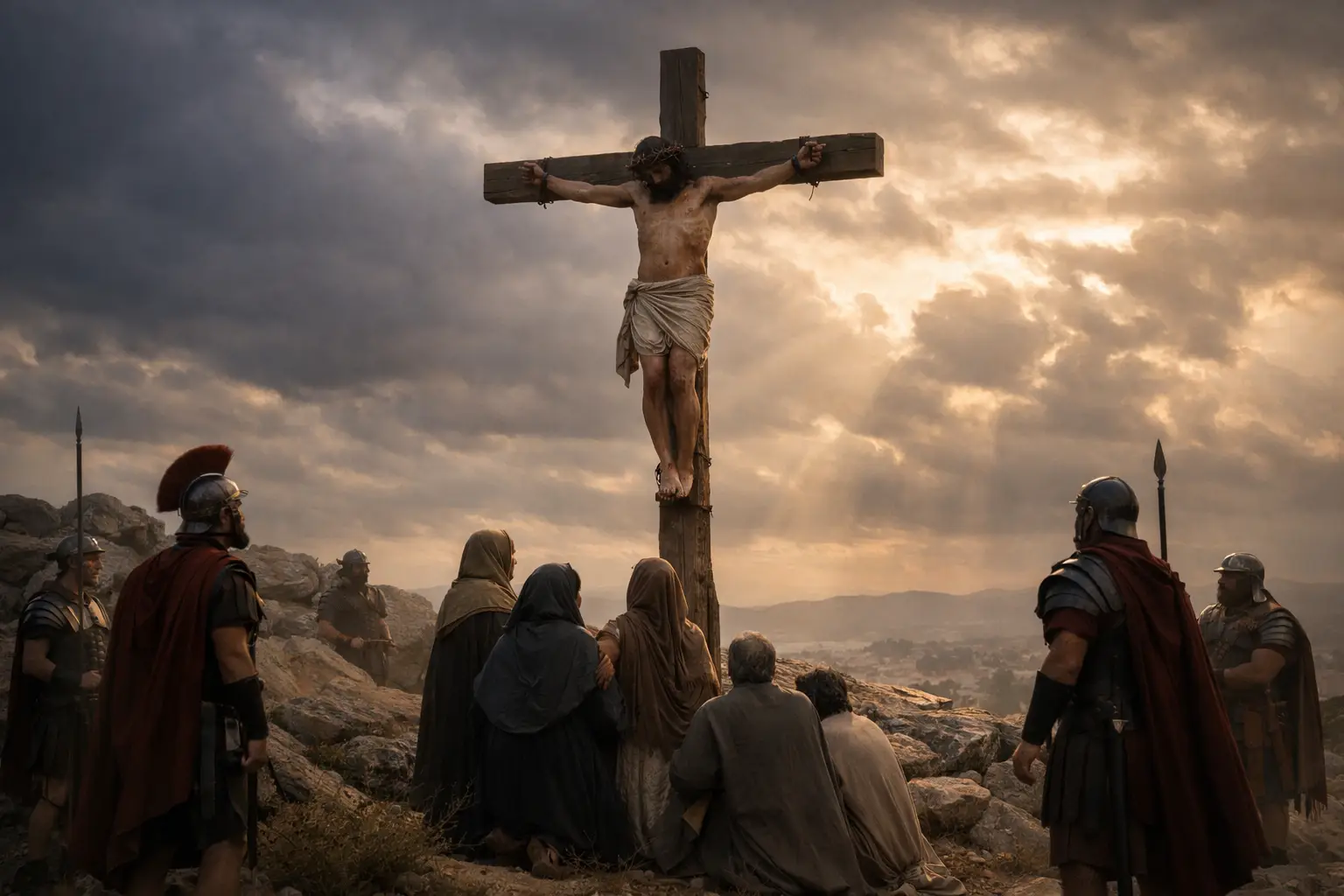
Calvary was not only the place where Jesus died. It was also the place where He spoke with striking clarity in the midst of agony. The words of Jesus on the cross are few, but they are not small. In them, we hear His mercy toward sinners, His care for His mother, His fulfillment of Scripture, His true human suffering, and His complete trust in the Father.
Christians have often referred to these statements as the seven sayings from the cross. They are gathered from the four Gospels, and each one deserves careful attention. When we read them together, we do not simply collect memorable lines from a tragic event. We are listening to the crucified Son of God interpret His own mission while He completes it.
Why the words of Jesus on the cross matter
Jesus did not waste words. That is true throughout the Gospels, and it is especially true here. His final statements before death help us understand what His crucifixion meant.
These sayings show that the cross was not an accident, a defeat, or merely an example of courage. Jesus remained fully aware of what He was doing. Even while bearing suffering beyond our full understanding, He continued teaching, forgiving, fulfilling Scripture, and entrusting Himself to the Father.
For pastors, teachers, and everyday believers, this matters deeply. If we want to understand the meaning of the cross, we should listen closely to what Jesus said while He was on it.
The seven words of Jesus on the cross
“Father, forgive them, for they do not know what they do”
In Luke 23:34, Jesus begins not with self-defense, but with intercession. He prays for those who are crucifying Him. Roman soldiers carried out the execution. Religious leaders demanded it. Crowds mocked Him. Yet His response was, “Father, forgive them.”
This does not mean their sin was small. It means His mercy was great. Ignorance did not make them innocent, but Jesus still prayed for forgiveness. Here we see the heart of Christ plainly. He does not deny evil. He meets it with holy mercy.
This saying also reflects His own teaching. He had commanded His followers to love their enemies and pray for those who persecute them. On the cross, Jesus practices what He preached. His words and His life remain perfectly aligned.
“Truly, I say to you, today you will be with me in paradise”
In Luke 23:43, one of the criminals crucified beside Jesus turns to Him in faith. He says, “Jesus, remember me when you come into your kingdom.” The man has no good works to offer, no time to repair his life, and no ability to prove himself. He simply entrusts himself to the King beside him.
Jesus answers with assurance: “Today you will be with me in paradise.” This is one of the clearest pictures of salvation by grace in all of Scripture. The dying man is not saved because he has earned favor. He is saved because he turns to Jesus in faith.
At the same time, this is not cheap grace. The criminal acknowledges his own guilt and recognizes Jesus’ innocence and kingship. His faith is humble, honest, and direct. Jesus receives him immediately.
“Woman, behold, your son!… Behold, your mother!”
In John 19:26-27, Jesus sees His mother and the disciple whom He loved standing nearby. He says to Mary, “Woman, behold, your son,” and to John, “Behold, your mother.” From that hour, John took her into his home.
Even in the suffering of crucifixion, Jesus shows tender concern for His mother. This is not a distraction from His mission. It is part of the beauty of His obedience. The Savior who bears the sin of the world also honors His mother with practical care.
There is something instructive here for believers. Deep spirituality is not detached from ordinary faithfulness. Jesus fulfills the greatest redemptive work in history while also attending to a very personal need. Love for God and love expressed in human relationships are not rivals.
“My God, my God, why have you forsaken me?”
Matthew 27:46 and Mark 15:34 record perhaps the most solemn of all the sayings from the cross. Jesus cries out in the words of Psalm 22, “My God, my God, why have you forsaken me?”
These words should be handled with reverence. They do not mean Jesus stopped being the Son of God, nor do they suggest the Trinity was broken apart in some simple mechanical sense. But they do reveal the real horror of the cross. Jesus, the sinless One, was bearing sin and entering into the judgment that sin deserves.
This cry is both deeply personal and deeply biblical. Jesus expresses true anguish, and He does so with Scripture on His lips. Psalm 22 begins in desolation but ends in vindication and worship. By quoting it, Jesus is not only voicing suffering. He is also locating His suffering within the plan of God already revealed in Scripture.
There is mystery here, and faithful Christians have explained the details in different ways. Still, the central truth is clear. On the cross, Jesus endured what was necessary to accomplish our redemption. His suffering was real, costly, and unlike any other.
“I thirst”
John 19:28 records these simple words: “I thirst.” John tells us Jesus said this to fulfill the Scripture.
This statement reminds us that the One on the cross was truly human. He was not pretending to suffer. He was not untouched by pain. He experienced physical torment, exhaustion, blood loss, and thirst.
Yet John also points us to more than physical need. Jesus remained conscious that Scripture was being fulfilled. Even near death, He moved with awareness of the Father’s will. The One who once said, “If anyone thirsts, let him come to me and drink,” now Himself thirsts as He completes the work of salvation.
There is a profound exchange here. The giver of living water enters the dryness of suffering so that thirsty sinners might be brought to God.
“It is finished”
In John 19:30, Jesus declares, “It is finished.” This is not the voice of defeat. It is the announcement of completion.
What was finished? Not His influence, not His kingdom, and not God’s plan for history. What was finished was the work the Father had given Him to accomplish in His earthly suffering and sacrificial death. The obedient life had been lived. The Scriptures concerning His passion had been fulfilled. The offering was being brought to completion.
These words should give believers deep confidence. Jesus did not merely make salvation possible in some vague sense. He completed the work necessary for redemption. We still speak carefully here, because Scripture also calls people to repent, believe, and continue in faith. But the foundation of salvation is not our performance. It is the finished work of Christ.
“Father, into your hands I commit my spirit”
Luke 23:46 gives Jesus’ final saying before He dies: “Father, into your hands I commit my spirit.” He is quoting Psalm 31:5, once again meeting death with Scripture.
Notice how the cross begins and ends with “Father.” Jesus’ first recorded saying from the cross is a prayer for forgiveness. His last is a prayer of trust. He suffers in full dependence on the Father and dies in full confidence in the Father.
This is not resignation. It is surrender without fear. Jesus’ life is not taken from Him in the ultimate sense. He lays it down willingly. Even in death, He is the obedient Son.
Reading these sayings together
Each saying has its own emphasis, but together they form a powerful testimony. Jesus forgives sinners, welcomes the repentant, cares for His own, bears unspeakable anguish, fulfills Scripture, completes His mission, and entrusts Himself to the Father.
If we isolate only one saying, we may miss the full picture. “Father, forgive them” shows mercy, but “It is finished” shows accomplishment. “I thirst” shows true humanity, but “Today you will be with me in paradise” shows divine authority. “My God, my God, why have you forsaken me?” shows the depth of suffering, while “Father, into your hands I commit my spirit” shows unwavering trust.
This is one reason careful Bible study matters. The Gospels do not flatten Jesus into a single theme. They present Him in the fullness of His person and work.
What the words of Jesus on the cross mean for us now
These sayings are not only for theological reflection. They call for response.
If Jesus prayed for His enemies, we cannot cling to an unforgiving spirit without resisting His example. If He welcomed a dying sinner who turned to Him in faith, no one should think it is too late to come to Christ. If He trusted the Father in suffering, believers can learn to entrust themselves to God even when His ways are hard to understand.
They also remind us where hope is found. Not in vague spirituality, not in moral effort alone, but in the crucified and risen Christ. The cross tells the truth about human sin, and it tells the truth about divine mercy.
When you read these words, do more than admire them. Read them slowly in their Gospel context. Ask what they reveal about Jesus, what they fulfill in Scripture, and what they require of your own heart. If you want to keep growing in that study, resources from JesusSaid.tv can help you continue examining His words with care and confidence. The closer we listen to Jesus at the cross, the more clearly we see the Savior who loved us to the end.