If you have ever asked, what is the first words of Jesus, the answer depends on where you begin reading the Bible and what you mean by “first.” That question is worth slowing down for, because the first recorded words of Jesus reveal something essential about who He is, why He came, and what mattered to Him from the very beginning.
What Is the First Words of Jesus in the Bible?
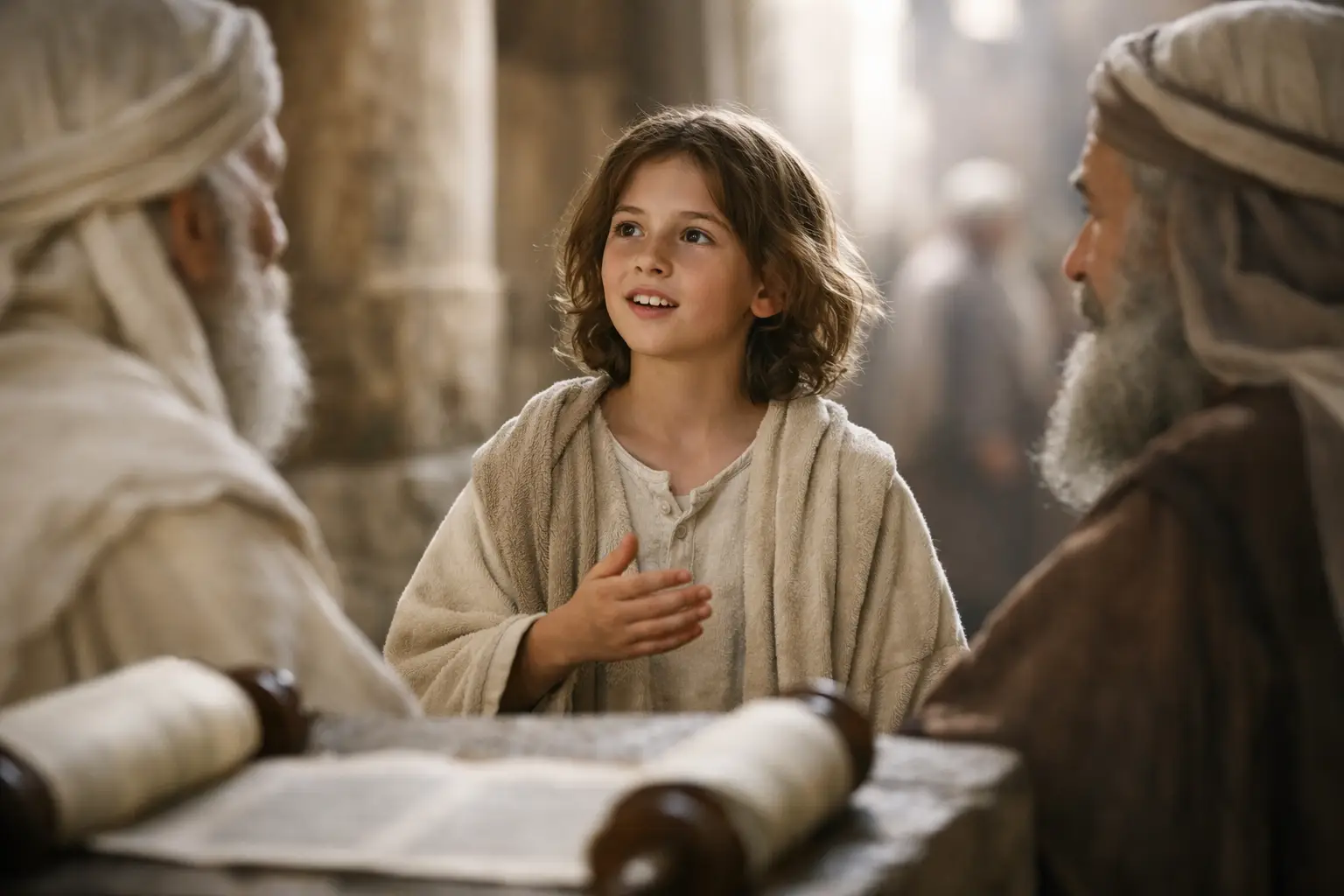
The first recorded words of Jesus in the New Testament appear in Luke 2:49. At twelve years old, after His parents found Him in the temple, Jesus said, “Why did you seek Me? Did you not know that I must be about My Father’s business?”
Some Bible translations render the final phrase slightly differently, such as “in My Father’s house,” because the underlying expression can carry both ideas. In either case, the meaning is clear. Even as a boy, Jesus spoke with a settled awareness of His unique relationship to the Father and of His divine mission.
That is the simplest answer to the question. The first recorded words spoken by Jesus during His earthly life are found in Luke, and they direct attention immediately to His Father.
Why This Answer Sometimes Confuses People
There is a reason this question can produce different answers in conversations, Bible studies, or online searches. People are often asking one of several different questions without realizing it.
Some mean, “What are the first recorded words Jesus spoke as a child on earth?” In that case, Luke 2:49 is the answer.
Others mean, “What are the first words Jesus spoke at the beginning of His public ministry?” In that case, readers often turn to Matthew 4:17: “Repent, for the kingdom of heaven is at hand.” That is not His first recorded statement overall, but it is the opening message of His public preaching in Matthew’s Gospel.
Still others are thinking more broadly. Because Jesus is the eternal Word, some Christians point to His divine activity before Bethlehem. The Gospel of John teaches that all things were made through Him, and the Old Testament contains moments where the Lord speaks before the incarnation. That is a larger theological discussion, but it is different from asking about the first recorded words of Jesus in the Gospel narratives.
So the right answer depends on the frame of the question. If we are asking about the first words attributed to Jesus in the Gospels, Luke 2:49 is the key text.
The Setting of Jesus’ First Recorded Words
Luke gives the scene with remarkable simplicity. Joseph and Mary had gone to Jerusalem for the Passover. When they began their return journey, they assumed Jesus was with the larger group. After realizing He was missing, they returned to Jerusalem and found Him in the temple, sitting among the teachers, listening and asking questions.
Luke says the people who heard Him were astonished at His understanding and answers. When His mother spoke to Him with understandable concern, Jesus replied, “Why did you seek Me? Did you not know that I must be about My Father’s business?”
This moment matters because it is not merely a story about a gifted child. It is a revelation of identity. Jesus is not distancing Himself from Mary and Joseph in a cold or dismissive way. In fact, Luke goes on to show His submission to them as He returned to Nazareth. But He is making something unmistakably clear. His highest allegiance is to the Father, and His life is governed by that calling.
What Jesus Reveals About Himself
The first recorded words of Jesus are not random. They are deeply revealing.
He knew God as His Father
Jesus does not speak of God in general terms. He says, “My Father.” That language points to a unique sonship. Faithful Israelites called God Father in a covenant sense, but Jesus speaks with a singular intimacy and authority that prepares readers for the full testimony of the Gospels.
From the beginning, His identity is tied to the Father in a way no one else can claim. Later, this relationship becomes central to His teaching, His prayers, and His works.
He understood His mission
Jesus says He “must” be about His Father’s business or in His Father’s house. That word “must” appears often in the Gospels. It signals divine necessity. Jesus is not drifting through history. He is living in conscious obedience to the Father’s will.
Even at twelve, He understands that His life has a purpose rooted in heaven, not merely in human expectation.
He placed the Father first
These first recorded words set the direction for everything that follows. Jesus will later say that He does nothing on His own authority, that He always does the things that please the Father, and that His food is to do the will of the One who sent Him. Luke 2:49 is the early window into that lifelong obedience.
What Is the First Words of Jesus and Why It Matters Today
For many readers, this can feel like a small Bible trivia question. But Scripture rarely gives details just to satisfy curiosity. The first recorded words of Jesus matter because they help us see what was central to Him.
His first words are not about self-promotion, comfort, or public recognition. They are about the Father. That alone should cause every believer to pause. If we want to understand Jesus rightly, we must begin where He began – with the Father’s will, the Father’s house, and the Father’s business.
There is also a gentle correction here for our own discipleship. Many people want Jesus as Savior but give little thought to His priorities. Yet His first recorded words show a life ordered entirely around God. To follow Christ is not only to admire Him. It is to be reshaped by what governed Him.
A Word About the Different Gospel Emphases
It also helps to notice that each Gospel writer emphasizes different moments for different reasons. Luke is the one who records this childhood event. Matthew moves quickly toward Jesus’ public proclamation, where “Repent, for the kingdom of heaven is at hand” becomes a major opening declaration. John, in a different way, begins by revealing who Jesus is as the eternal Word who was with God and was God.
These are not contradictions. They are complementary portraits. Luke gives us the first recorded words from Jesus’ youth. Matthew highlights the opening burden of His public preaching. John places Jesus within the eternal reality of God’s redemptive plan.
That means careful Bible reading asks not only, “What did Jesus say first?” but also, “Why does this Gospel writer want me to see this moment first?” In Luke, the answer is clear. Before Jesus performs miracles, gathers disciples, or teaches crowds, we are invited to see His devotion to the Father.
How Believers Should Respond
The first recorded words of Jesus invite more than observation. They call for response.
First, they call us to treasure the Father as Jesus did. The Christian life is not centered on religious activity for its own sake. It is centered on knowing, loving, and obeying God.
Second, they remind us that true identity is found in relationship to the Father. Jesus knew who He was, and that shaped how He lived. Believers do not share His divine sonship in the same way, but through Him we are brought near and taught to pray, “Our Father.”
Third, they urge us to take seriously the things of God. The temple setting is significant. Jesus was not indifferent to the truth of God, the worship of God, or the Word of God. He was drawn to them. A life shaped by Christ will not treat these things casually.
Finally, these words encourage us to read the rest of the Gospels with greater attention. If His first recorded words point to the Father, then His later teachings should be heard with the same seriousness. His words are not one voice among many. They are the words of the Son who came to do the Father’s will perfectly.
There is something fitting about beginning with a question as simple as what is the first words of Jesus and ending with a clearer view of His heart. His first recorded words direct us to His Father. If you want to know Jesus more deeply, keep following that direction through the Gospels, and let His words set the center of your faith and daily life.