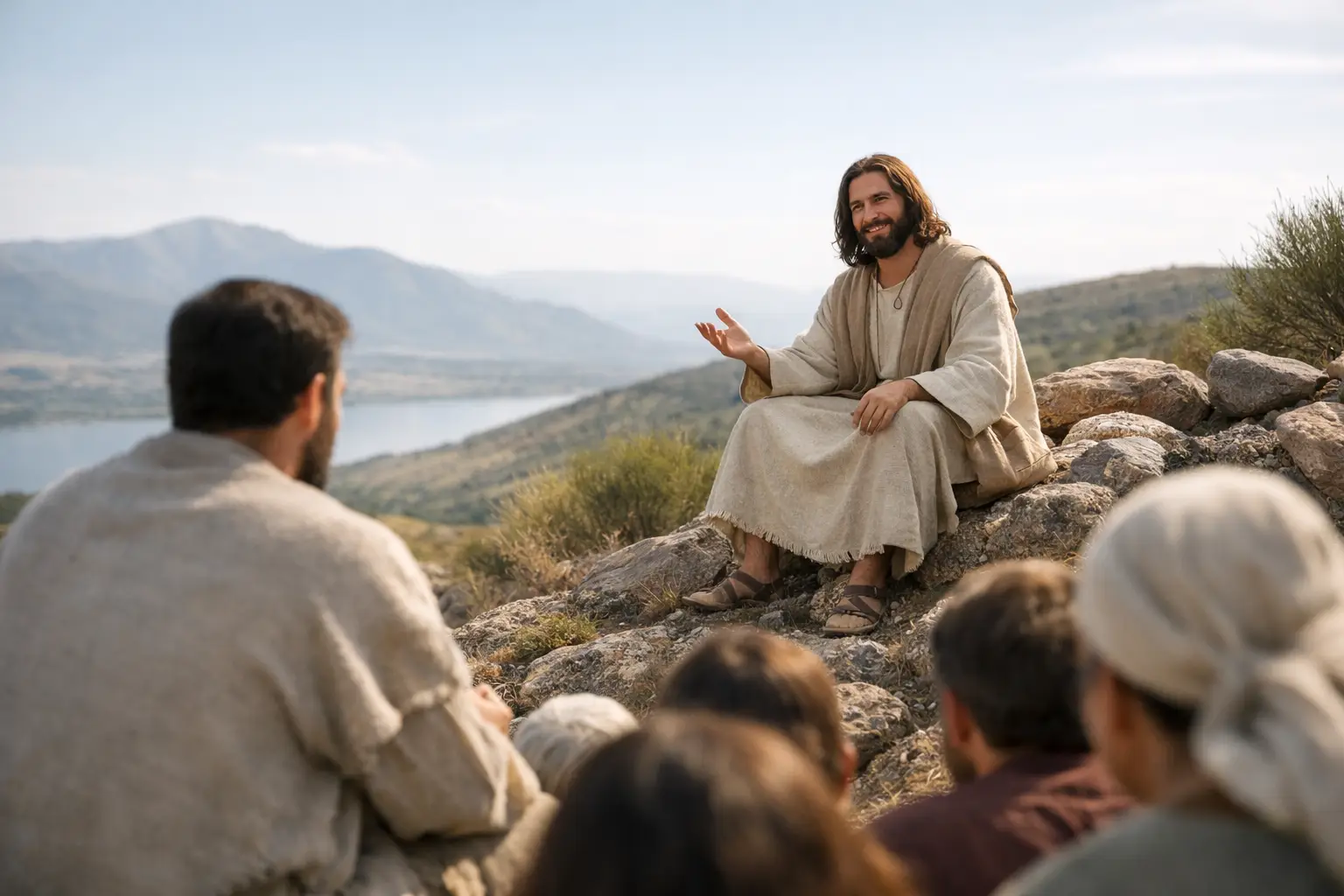
Jesus did not deliver the Sermon on the Mount as a collection of uplifting sayings for occasional encouragement. He spoke with the authority of the King, calling His disciples into the life of God’s kingdom. A sermon on the mount explained rightly begins here: Jesus is showing what it looks like to live under His rule, from the posture of the heart to the ordinary decisions of daily life.
Found in Matthew 5-7, this teaching has challenged, comforted, and corrected believers for centuries. Its words are familiar: love your enemies, do not worry, ask and it will be given, and build on the rock. Yet familiarity can make these commands seem easier than they are. Jesus is not asking for religious appearance. He is calling for a righteousness that reaches the heart.
The Setting and Purpose of Jesus’ Sermon
Matthew tells us that Jesus went up a mountain, sat down, and taught His disciples while crowds were also present (Matthew 5:1-2). The mountain setting recalls Moses receiving God’s law, but Jesus does not merely repeat Moses. He speaks as the Son who authoritatively reveals the Father’s will. Again and again, He says, “But I say to you.”
This matters because the sermon is sometimes treated as either impossible idealism or a simple moral program. Neither approach does justice to Jesus’ words. The Sermon on the Mount reveals God’s holy standard, exposes the inadequacy of outward religion, and describes the transformed life Jesus produces in those who follow Him.
It is not a ladder by which sinners earn acceptance with God. Jesus begins His ministry proclaiming the kingdom and calling people to repent and believe. Elsewhere, He came “to give his life as a ransom for many” (Matthew 20:28). Forgiveness and reconciliation with God rest on God’s grace, not on human moral achievement. But grace never leaves a person unchanged. The One who saves His people also teaches them how to live as His people.
Sermon on the Mount Explained: Kingdom Character
The sermon opens with the Beatitudes, declarations of blessing for people who may not appear blessed by the world’s standards. Jesus calls blessed the poor in spirit, those who mourn, the meek, those who hunger and thirst for righteousness, the merciful, the pure in heart, the peacemakers, and those persecuted for righteousness’ sake (Matthew 5:3-12).
These are not eight separate ways to gain God’s favor. Together, they portray the character of those who belong to Jesus’ kingdom. The poor in spirit know their need before God. Those who mourn do not make peace with sin and suffering. The meek surrender self-importance. Those who hunger for righteousness want God’s will to be done in their own lives and in the world.
This opening corrects a common assumption: blessedness is not measured by comfort, popularity, wealth, or control. Jesus promises the kingdom to those who depend on God. He promises comfort to those who grieve. He promises a future inheritance to the meek. His promises are both present and future. Believers experience the kingdom now, while still awaiting its full fulfillment when Christ reigns openly.
Jesus then tells His disciples that they are the salt of the earth and the light of the world. Salt preserves and gives flavor; light makes what is true visible. Disciples are not called to withdraw from a dark world in fear, nor to blend into it until they are indistinguishable. Their good works are meant to point beyond themselves, so that others “give glory to your Father who is in heaven” (Matthew 5:16).
A Righteousness That Goes Deeper
One of the sermon’s central statements appears in Matthew 5:20: “Unless your righteousness exceeds that of the scribes and Pharisees, you will never enter the kingdom of heaven.” Jesus is not criticizing obedience to God’s law. He is confronting a righteousness limited to external observance while the heart remains untouched.
In six examples, Jesus brings God’s commands to their intended depth. Murder is not the only issue; unjust anger and contempt also matter. Adultery is not the only concern; lustful intent is a matter of the heart. Truthfulness is not satisfied by carefully worded oaths; Jesus calls His followers to be people whose simple yes and no can be trusted.
These teachings should lead us to honest self-examination. A person may avoid visible scandal while nurturing bitterness, pride, dishonesty, or sexual sin inwardly. Jesus sees beyond behavior to motives, desires, and hidden loyalties. That is sobering, but it is also hopeful. He does not merely restrain destructive actions. He transforms the source from which actions flow.
Jesus’ command to love enemies is among the clearest marks of this kingdom righteousness. “Love your enemies and pray for those who persecute you” (Matthew 5:44). This is not permission to ignore evil, deny justice, or remain in an unsafe situation. Scripture recognizes the reality of wrongdoing and the need for wise protection. But Jesus forbids His followers from feeding revenge in their hearts. They are to seek God’s good purposes even toward those who oppose them, reflecting the Father who gives sun and rain to the righteous and unrighteous alike.
Devotion Before the Father, Not Before an Audience
Matthew 6 turns to giving, prayer, and fasting. Jesus warns against practicing righteousness “before other people in order to be seen by them.” The problem is not public service or public prayer. Jesus Himself prayed publicly at times. The problem is performing spiritual activity to secure human praise.
The Father sees what is done in secret. That truth both humbles and comforts. It humbles us because hidden motives are not hidden from God. It comforts us because faithfulness that receives no public recognition is fully seen by Him.
When Jesus teaches His disciples to pray, He gives what is often called the Lord’s Prayer. Its opening is God-centered: “Our Father in heaven, hallowed be your name.” Prayer begins not with our urgency but with the Father’s name, kingdom, and will. Only then does Jesus teach us to ask for daily bread, forgiveness, and protection from temptation.
This pattern is not meant to make prayer mechanical. It teaches priorities. We bring real needs to God, including material needs and the daily struggle against sin. Yet we come as children to a holy Father, asking that His will shape our desires. Jesus also connects receiving forgiveness with extending forgiveness. Those who have been shown mercy are called to relinquish personal vengeance and forgive others, even when that process requires prayer, wisdom, and time.
Trusting God in a Divided World
Jesus speaks directly to the pull of possessions and anxiety. “Where your treasure is, there your heart will be also” (Matthew 6:21). Money and possessions can be used gratefully and generously, but they make cruel masters. Jesus says plainly, “You cannot serve God and money.”
His command not to be anxious is not a denial that people face real needs. Jesus mentions food, drink, and clothing, the basic concerns of life. His point is that the Father knows these needs before we ask. Birds are fed, flowers are clothed, and human beings are of far greater value to God.
“Seek first the kingdom of God and his righteousness” is therefore not a promise of luxury. It is a call to put the Father’s reign first and entrust tomorrow to Him (Matthew 6:33-34). Christians still plan, work, save, and care responsibly for their households. Trust is not passivity. It is refusing to let fear become our master while we obey God faithfully today.
The Narrow Way and the Solid Foundation
The final chapter presses for discernment and decision. Jesus warns against hypocritical judgment, not against all moral discernment. Before addressing another person’s fault, we must first deal honestly with our own sin. Humility makes correction more truthful and more compassionate.
He tells His followers to ask, seek, and knock, trusting the Father’s goodness. He gives the Golden Rule: “Whatever you wish that others would do to you, do also to them” (Matthew 7:12). He warns that the way leading to life is narrow, that false prophets can be recognized by their fruit, and that verbal claims alone do not prove genuine obedience.
The sermon ends with two builders. One hears Jesus’ words and does them; his house stands when rain, floods, and winds strike. The other hears but does not do them; his house falls (Matthew 7:24-27). The difference is not exposure to Jesus’ teaching. Both builders hear. The difference is obedient response.
The Sermon on the Mount should not leave us admiring Jesus from a safe distance. It invites us to come under His words with faith, repentance, and expectation that He can change us. Read Matthew 5-7 slowly, asking where your life is being shaped by approval, anger, fear, or self-reliance. Then bring that area to Christ. His words matter, and the wise life is built by hearing Him and doing what He says.