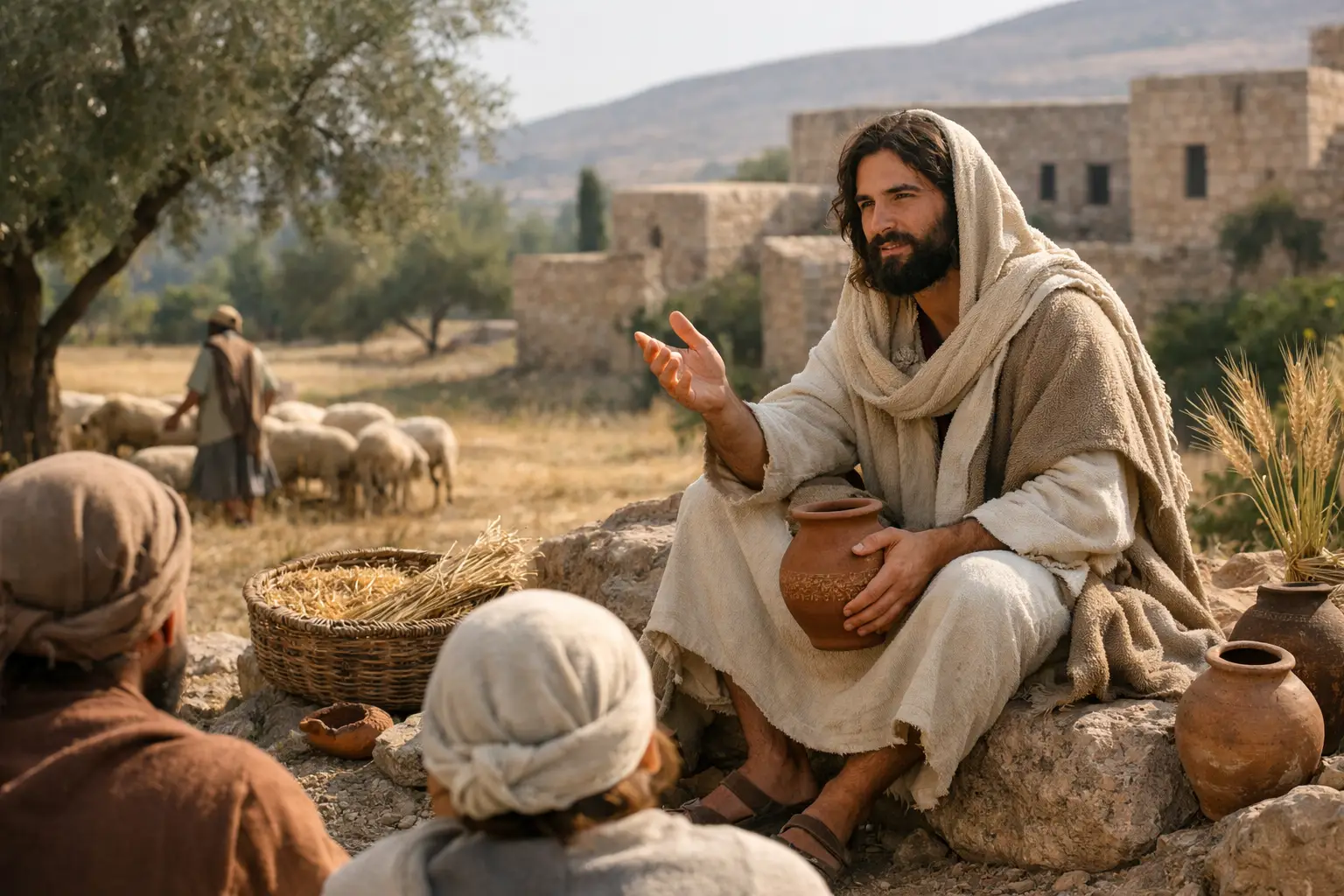
Jesus often taught with scenes His listeners knew well: a farmer scattering seed, a shepherd searching for a sheep, a father watching the road for his son. Yet these familiar stories are not merely moral illustrations. This guide to Jesus’ parables meanings begins where Jesus began: with His words, His audience, and His call to respond to the kingdom of God.
A parable can be simple enough for a child to remember and deep enough to search for a lifetime. Jesus used them to reveal truth to receptive hearts and to confront those who heard Him without yielding to Him. The goal is not simply to identify the lesson of a story. It is to hear the King speak and to obey Him.
Why Jesus Taught in Parables
In Matthew 13, after telling the parable of the sower, the disciples asked Jesus why He spoke to the crowds in parables. Jesus answered that the secrets of the kingdom of heaven had been given to His disciples to know, while others, though hearing, did not truly hear. He then connected this response to Isaiah’s description of people whose hearts had grown dull.
This does not mean parables were riddles meant to keep sincere seekers away. Jesus welcomed those who came to Him, asked questions, and desired to understand. He explained the parable of the sower privately to His disciples. But His stories also exposed a serious reality: a person may listen to God’s truth, admire Jesus’ wisdom, and still refuse His authority.
Parables invite us to slow down. They press beyond the question, “What does this story mean?” to ask, “What does Jesus require of me?”
How to Read Jesus’ Parables Faithfully
The best way to understand a parable is not to begin with a modern opinion or an imagined symbolism for every object in the story. Begin with the passage itself. Read what comes before and after it. Notice whom Jesus is addressing and what question, conflict, or event prompted the teaching.
Listen for Jesus’ own explanation
When Jesus explains a parable, His explanation must guide ours. In the parable of the sower, found in Matthew 13, Mark 4, and Luke 8, Jesus identifies the seed as the word of God and describes the different soils as different responses to that word. We do not need to invent a hidden meaning for the birds, rocks, thorns, or good soil. Jesus has already given the central interpretation.
His explanations also show that parables are meant to be personal. The issue is not whether we can describe four kinds of soil. The issue is whether we receive His word, persevere through trouble, resist the choking pull of worldly cares and riches, and bear fruit.
Keep the main point in view
Some parables contain rich details, but not every detail carries an independent spiritual message. The main point usually rises from the setting, the surprise in the story, and the response Jesus calls for.
For example, the parable of the workers in the vineyard in Matthew 20 is not primarily a formula for setting wages. Jesus uses the landowner’s generosity to challenge resentment and to show that God’s grace is not earned by comparison with others. The story follows Jesus’ teaching about reward, sacrifice, and the first being last. Its purpose is to humble those who think they can claim God’s favor as a debt.
Read each parable in the light of the kingdom
Jesus repeatedly introduced parables by saying, “The kingdom of heaven is like…” His stories announce God’s reign in and through Christ. They reveal the character of the Father, the seriousness of sin, the call to repentance, the cost of discipleship, and the coming judgment.
This kingdom focus protects us from reducing every parable to general advice. The Good Samaritan certainly calls us to merciful action, but it is more than a reminder to be nice. The parable answers a lawyer who wanted to justify himself after hearing the command to love God and neighbor. Jesus overturns the man’s attempt to limit the definition of neighbor and commands, “Go and do likewise” (Luke 10:37).
A Guide to Jesus’ Parables Meanings in Five Stories
The sower: receive the word and bear fruit
The parable of the sower teaches that the same word can meet very different hearts. Some hear without understanding, some respond with temporary enthusiasm, some allow competing loves to choke the word, and some receive it fruitfully.
The warning is searching but hopeful. Jesus does not ask us to manufacture spiritual fruit by willpower alone. He calls us to hear His word, hold it fast, and endure. A fruitful life grows from a heart continually receptive to Christ.
The Good Samaritan: mercy crosses the boundaries we prefer
The wounded man in Luke 10 was passed by religious figures who saw his need but did not help. The Samaritan, a person many Jewish listeners would have viewed with suspicion, became the neighbor. He moved toward suffering at personal cost.
Jesus’ command is plain: “Go and do likewise.” Christian love cannot remain an abstract belief. It becomes visible when we give time, compassion, attention, and practical help to someone whose need interrupts our plans. Wisdom may shape how we help, but indifference cannot be called obedience.
The lost sheep and the lost coin: heaven rejoices over repentance
In Luke 15, Jesus spoke these parables because religious leaders complained that He welcomed sinners and ate with them. The shepherd seeks one lost sheep. A woman carefully searches for one lost coin. Both rejoice when what was lost is found.
Jesus’ point is unmistakable: there is joy in heaven over one sinner who repents. These stories reveal the pursuing mercy of God and correct the cold spirit that resents grace offered to others. If we rejoice in God’s mercy toward us, we should not begrudge His mercy toward those we once considered far away.
The two sons: come home to the Father’s mercy
The parable often called the prodigal son continues Luke 15. The younger son dishonors his father, wastes his inheritance, and returns intending to plead for a lesser place. Instead, the father runs to him, receives him, and restores him.
But the older brother is also lost in a different way. Though physically near the father, he is angry at grace and counts his service as a claim against him. Jesus leaves the story without telling us whether the older brother joins the celebration. The open ending confronts every self-righteous heart.
Repentance means more than feeling regret when sin brings painful consequences. The younger son arose and went to his father. Faith turns toward God, trusting His mercy rather than demanding to be treated according to our record.
The talents: faithfully serve the King who entrusts much
In Matthew 25, a master entrusts resources to his servants before departing. In this setting, a talent is a large unit of money, not merely a natural ability. The servants are accountable for what the master placed in their care.
The parable should not be used to create anxiety over achievement or to promise financial increase. Its central concern is faithful stewardship and readiness for the Master’s return. Every believer has received opportunities, time, responsibilities, and gifts under Christ’s authority. Fear may tempt us to bury what God has entrusted, but faithful service begins with knowing the character of our King and acting on His command.
Let the Parables Examine Your Life
Jesus’ parables do not permit spectatorship for long. They ask whether we are hearing His word deeply, loving our neighbor concretely, rejoicing when sinners repent, returning to the Father, and serving faithfully while we await Christ’s return.
Application requires care. A parable may confront one reader with material distraction and another with reluctance to forgive. We should not force an application the text does not support. At the same time, we should resist keeping Jesus’ teaching safely distant. Prayerfully ask, “Lord, where am I resisting what You are saying?” Then take a specific step of obedience.
Reading parables alongside the Gospels also matters. Jesus is not only the teacher of these stories. He is the fulfillment of the kingdom He proclaims. In Him, the lost are sought, sinners are called to repentance, mercy is displayed, and disciples are summoned to follow.
As you read one parable this week, read it aloud, note Jesus’ audience, and remain with His closing words. Let the story lead you beyond familiarity into faithful hearing. Jesus still says, “He who has ears to hear, let him hear.”
Leave a Reply