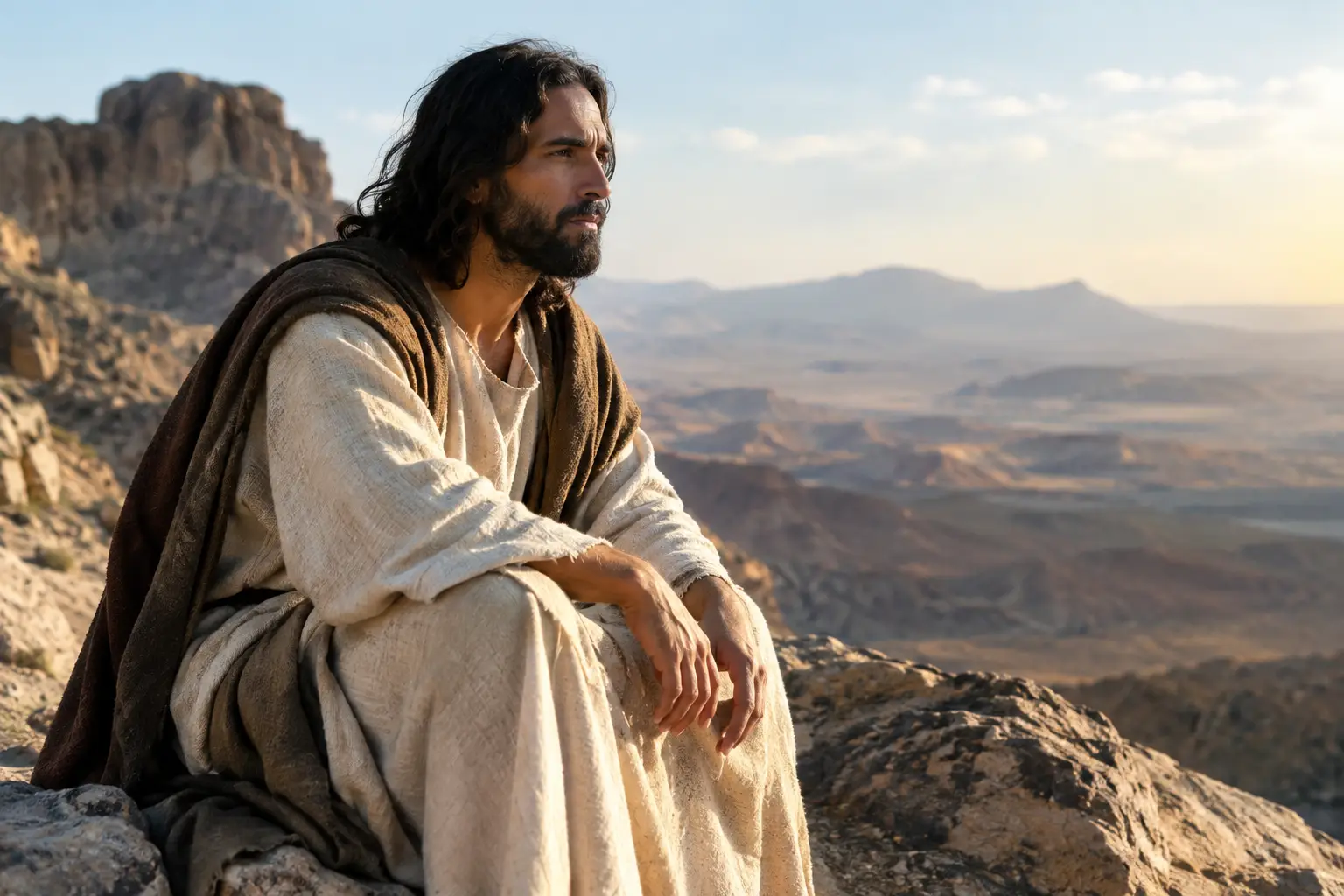
Forty days without food in the wilderness would expose anyone’s physical limits. Yet the account of Jesus’ temptation reveals something far deeper than endurance. In this Jesus wilderness temptation study, we see the Son of God meet real hunger, pressure, and opposition without stepping outside His Father’s will. His response gives believers more than an example of self-control. It shows us what faithful trust looks like when a shortcut appears reasonable.
Matthew 4:1-11 and Luke 4:1-13 place this event at a crucial moment. Jesus has just been baptized, the Spirit has descended upon Him, and the Father has declared, “This is My beloved Son.” Then the Spirit leads Him into the wilderness. The setting matters: testing follows affirmation, and the wilderness becomes the place where Jesus’ identity and mission are challenged.
The Setting of Jesus’ Wilderness Temptation
Matthew tells us that Jesus was “led up by the Spirit into the wilderness to be tempted by the devil.” This does not mean the Father tempted Jesus toward evil. Scripture is clear that God does not tempt anyone with evil. Rather, the Spirit led Jesus into a setting where His obedience would be tested and displayed, while the devil sought to lure Him from the path of obedience.
Jesus had fasted forty days and nights. His hunger was not symbolic. It was real. The devil’s temptations therefore came at a point of genuine human weakness. Jesus did not meet them from a distance, as though the pressures were unreal. He faced them as the incarnate Son, fully faithful to the Father in the conditions of ordinary human need and suffering.
The forty days also recall Israel’s forty years in the wilderness. Israel was called God’s son, yet repeatedly failed to trust and obey Him. Jesus, the beloved Son, stands where Israel failed. His quotations from Deuteronomy are not accidental. He answers from passages that address Israel’s wilderness experience, showing that He fulfills God’s purpose with perfect obedience.
Three Temptations, One Central Challenge
Although the temptations differ, each presses the same question: Will Jesus live as the Father has called Him to live, or will He seize a different way? Satan repeatedly challenges Him with the words, “If You are the Son of God.” The issue is not whether Jesus truly is God’s Son. The Father has already declared it. The temptation is to prove that identity independently, on Satan’s terms.
Turn Stones Into Bread
The first temptation comes with a practical appeal: “If You are the Son of God, command that these stones become bread.” Hunger itself was not sinful, and eating bread would not have been sinful. The issue was whether Jesus would use His power at the devil’s direction to satisfy Himself apart from the Father’s will.
Jesus answers, “Man shall not live by bread alone, but by every word that comes from the mouth of God.” He does not deny bodily need. Bread is a gift from God, and Jesus later teaches His disciples to pray for daily bread. But physical provision cannot become the highest authority in a believer’s life. A need is real, yet it does not give us permission to disobey God in meeting it.
This speaks directly to decisions made under pressure. Financial strain, loneliness, career uncertainty, and fear can make compromise look necessary. Jesus teaches us that survival is not the final measure of wisdom. The question is whether we will trust the Father and obey His word, even when obedience feels costly.
Throw Yourself Down
Next, the devil takes Jesus to the pinnacle of the temple and quotes Psalm 91, urging Him to throw Himself down so angels will rescue Him. Here Satan uses Scripture, but he uses it selectively and deceptively. He treats God’s promise of protection as permission for reckless self-display.
Jesus replies, “You shall not put the Lord your God to the test.” Faith does not demand that God prove Himself according to our timetable or our preferred drama. Trust rests in what God has said without manufacturing a crisis to force His hand.
This temptation warns us that biblical words can be removed from their purpose. It is possible to quote Scripture while resisting its meaning. Jesus answers Scripture with Scripture in proper context, honoring the Father rather than using the Bible to justify a desired outcome. For this reason, careful study is not merely academic. It guards the heart from using God’s Word for self-serving purposes.
Receive the Kingdom Without the Cross
In the final temptation, the devil shows Jesus the kingdoms of the world and offers their glory in exchange for worship. The offer is striking because Jesus is indeed the promised King. One day all authority in heaven and on earth will belong openly to Him. But Satan offers a crown without suffering, rule without the cross, and glory without obedience to the Father.
Jesus responds decisively: “You shall worship the Lord your God and Him only shall you serve.” There can be no shared allegiance. The devil’s offer is exposed for what it is: idolatry.
Every believer encounters smaller versions of this same temptation. We may be tempted to pursue influence, security, approval, or achievement by methods that dishonor Christ. The promise of a good outcome does not make an unfaithful path acceptable. Jesus refused the shortcut because worship belongs to God alone, and the Father’s way is never improved by disobedience.
How Jesus Answered the Enemy
A careful Jesus wilderness temptation study should not reduce the passage to a formula. Jesus is uniquely the sinless Son of God, and His victory is part of His saving work for us. We do not stand against temptation by copying His actions in our own strength. We stand through the grace He provides, relying on the Holy Spirit and submitting to God’s Word.
Still, His responses teach us a clear pattern. Jesus knew Scripture, trusted the Father, and rejected every invitation to define His mission by immediate appetite, public display, or worldly power. He did not debate the devil’s assumptions. He answered with truth.
The Word of God is not a collection of detached sayings to repeat mechanically. Jesus’ use of Deuteronomy shows a heart shaped by God’s revealed will. As believers read Scripture, memorize it, hear it taught faithfully, and obey it in daily choices, they grow in discernment. When temptation arrives, truth already planted in the heart helps expose the lie.
What This Means When We Are Tempted
The wilderness account should bring both sobriety and comfort. Temptation is not itself sin. Jesus was tempted, yet He did not sin. A believer who feels the pull of fear, anger, appetite, pride, or despair has not already failed. The question is what happens next: Will we entertain the lie, or bring our need honestly before God and choose obedience?
There is also a difference between resisting temptation and denying hardship. Jesus did not pretend He was not hungry. He trusted the Father in His hunger. Christians need not minimize pain or act as though every difficult circumstance has an easy answer. Sometimes wise action includes seeking counsel, receiving practical help, setting boundaries, or leaving a situation that invites sin. Trusting God is not passive.
When temptation feels persistent, Jesus’ example reminds us to return to what God has said. Name the pressure truthfully. Ask whether the proposed response requires compromise. Pray for strength. Bring the struggle into the light with mature believers when appropriate. Above all, remember that Jesus is not a distant observer of weakness. Hebrews tells us that He was tempted as we are, yet without sin, and therefore we may approach God’s throne of grace with confidence for mercy and help.
The wilderness did not define the end of Jesus’ story. After the testing, He began His public ministry proclaiming the kingdom of God. The Father’s way led through obedience, not around it. As you read Matthew 4 and Luke 4 again, listen carefully to Jesus’ words. Let His unwavering trust call you to the same steady confidence: the Father is worthy of worship, His Word is true, and His path is good even in the wilderness.
Leave a Reply