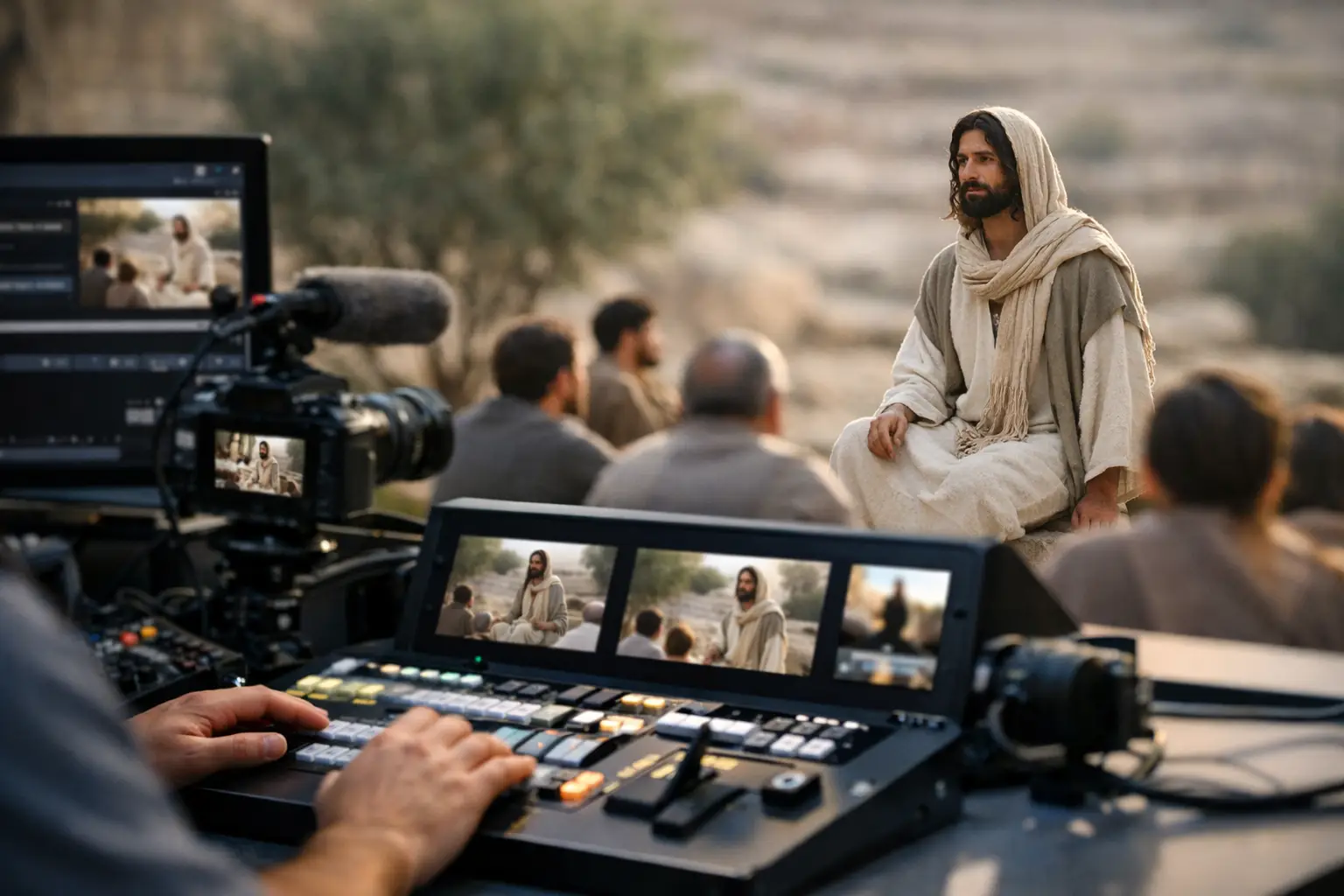
A sermon clip can reach someone in a hospital room, a Bible study can serve a parent after the children are asleep, and a simple Scripture graphic can interrupt a distracted scroll. Church media has real reach. Yet reach alone is not faithfulness. The central question is not merely whether a church can publish more content, but whether that content helps people hear, understand, and obey Jesus Christ.
Jesus gave His disciples a clear mission: “teaching them to observe all things that I have commanded you” (Matthew 28:20). That commission gives Christian media its proper purpose. Cameras, streaming platforms, websites, podcasts, screens, and social channels are tools. They can carry the message farther and make teaching more accessible. But they must never become more prominent than the message itself.
What Church Media Is Meant to Do
Church media is often described in technical terms: livestream production, video editing, sermon distribution, worship slides, social media, websites, and digital communication. Those functions matter, especially when they help a congregation participate, learn, and stay connected.
But Christian communication is more than content production. It is an act of stewardship. Every image, headline, video introduction, and teaching resource says something about what a church believes is worthy of attention. When media serves the church well, it directs attention beyond itself to the Lord.
Jesus said, “The words that I speak unto you, they are spirit, and they are life” (John 6:63). This does not diminish the rest of Scripture. Rather, it reminds us where Christian teaching must begin. The Gospels give us Christ’s words, His character, His priorities, His warnings, His promises, and His call to discipleship. The rest of Scripture supports, explains, and harmonizes with the teaching of the One whom Christians confess as Lord.
For that reason, media ministry is healthiest when it asks a simple question before publishing: Does this help people know what Jesus said and respond to Him faithfully?
Church Media Is Not the Same as Entertainment
A polished video is not automatically shallow, and a modest production is not automatically spiritual. Quality can be an expression of care for the people receiving a message. Clear sound helps people listen. Readable captions serve those who are deaf or watching without audio. Thoughtful editing can make a long teaching easier to follow.
Still, excellence has a different goal in ministry than it does in entertainment. Entertainment often seeks attention for its own sake. Christian media should seek understanding, worship, repentance, encouragement, and obedient faith. Jesus warned against doing righteous acts “to be seen of men” (Matthew 6:1). That warning reaches into public ministry as much as private devotion. A platform can be used to serve people, or it can become a place where visibility quietly replaces humility.
This is why churches should resist measuring every effort by views, shares, or follower counts. Those numbers may offer useful information, but they cannot measure whether a listener has forgiven an enemy, turned from sin, trusted Christ, served a neighbor, or grown in love for God. Jesus did not call His followers to collect an audience. He called them to make disciples.
Begin With the Teaching, Not the Platform
The most common church media question is often practical: Which platform should we use? That question has value, but it should come later. A wiser starting point is: What truth are we responsible to communicate, and whom are we trying to serve?
A local church may need a dependable livestream for members who are homebound or traveling. A Bible teacher may need short videos that introduce a passage and invite deeper study. A ministry serving several languages may need subtitles, transcripts, or translated teaching materials. The method depends on the people and the calling.
The message, however, should remain rooted in Scripture. Before preparing a sermon excerpt, a devotional video, or a social post, leaders should examine the biblical passage in context. If the content refers to Jesus, it should represent His words honestly rather than turning a brief phrase into a slogan detached from its setting.
For example, Jesus’ words, “Judge not, that ye be not judged” (Matthew 7:1), are frequently quoted without the surrounding teaching. In the same passage, Jesus confronts hypocrisy and calls His followers to remove the beam from their own eye before helping a brother with the speck in his eye. Faithful media does not merely repeat memorable lines. It helps people understand what Christ meant and how His words shape faithful living.
Make Clarity an Act of Love
Clarity is not a lesser form of depth. Jesus often used direct language, questions, stories, and familiar images to reveal God’s truth. He taught in ways that called for thought, but He did not hide the heart of His message behind unnecessary complexity.
Churches can follow that example by using plain titles, understandable summaries, legible text, and careful explanations of biblical terms. A viewer who is new to faith should not need insider knowledge to understand the basic invitation of the gospel. A mature believer should also find substance rather than vague encouragement.
This calls for discipline. A short post may be helpful, but some passages require a fuller teaching. A compelling clip may invite someone to listen, but it cannot replace the context of a sermon or Bible study. There is a trade-off between brevity and depth. Wise ministry uses brief content as a doorway, not as a substitute for serious engagement with God’s Word.
Build Trust Through Biblical Integrity
People can sense when religious content is designed mainly to provoke a reaction. Fear-based headlines, exaggerated promises, and selective quotations may gain attention for a moment, but they do not reflect the character of Christ. Jesus spoke truth plainly, including difficult truth, yet He did not manipulate people into belief.
Trust grows when a ministry is accurate, humble, and consistent. That means correcting mistakes when they occur, distinguishing Scripture from personal opinion, and avoiding claims that go beyond what the Bible says. It also means refusing to present popularity as proof of truth.
The apostle Paul instructed Timothy to “rightly divide the word of truth” (2 Timothy 2:15). Church media teams may not all be pastors or teachers, but everyone who prepares, edits, approves, or distributes teaching should recognize the weight of handling Scripture publicly. A beautiful presentation cannot repair a careless interpretation.
Leaders should also consider the people who are not yet persuaded. A seeker may encounter a thirty-second video before ever entering a church building or opening a Bible. The tone of that message matters. Is it truthful without being hostile? Does it invite honest examination? Does it point clearly to Jesus rather than pressure someone through emotion or spectacle?
Let the Local Church Remain a Living Body
Digital ministry can extend fellowship, but it cannot fully replace embodied fellowship. Believers are called to gather, encourage one another, bear burdens, pray, serve, and grow together. A livestream can help someone remain connected in a difficult season. It should not quietly teach that participation from a distance is always equivalent to belonging in a local body.
Jesus described His followers as people who love one another in a way the world can recognize (John 13:34-35). Church media should make that love visible in its posture and purpose. It can celebrate service, explain opportunities for prayer and discipleship, share teaching for those unable to attend, and help people take a real next step toward Christian community.
This is especially important when content is shared widely. The goal is not simply to send messages outward. It is to help people move toward Christ and, where possible, toward faithful relationships with His people.
Practical Questions Before You Publish
A church does not need a large production budget to practice biblical discernment. Before releasing a video, graphic, article, or sermon excerpt, a team can ask several questions:
- Is the Scripture quoted accurately and understood in context?
- Does this clearly point people toward Jesus and His teaching?
- Is the tone truthful, gracious, and free from manipulation?
- Will this help a person take a meaningful step in faith, study, prayer, or fellowship?
- Are we presenting the church or ministry as servants of Christ rather than as the main attraction?
These questions do not make every decision easy. A church may choose different formats based on its congregation, resources, and community. What should not change is the commitment to let the words of Christ govern the work.
At JesusSaid.tv, media is most valuable when it helps people return to the Gospels with open Bibles and willing hearts. The technology will continue to change. New platforms will come and go. But Jesus’ invitation remains steady: “If ye love me, keep my commandments” (John 14:15). Let every ministry tool serve that enduring call.