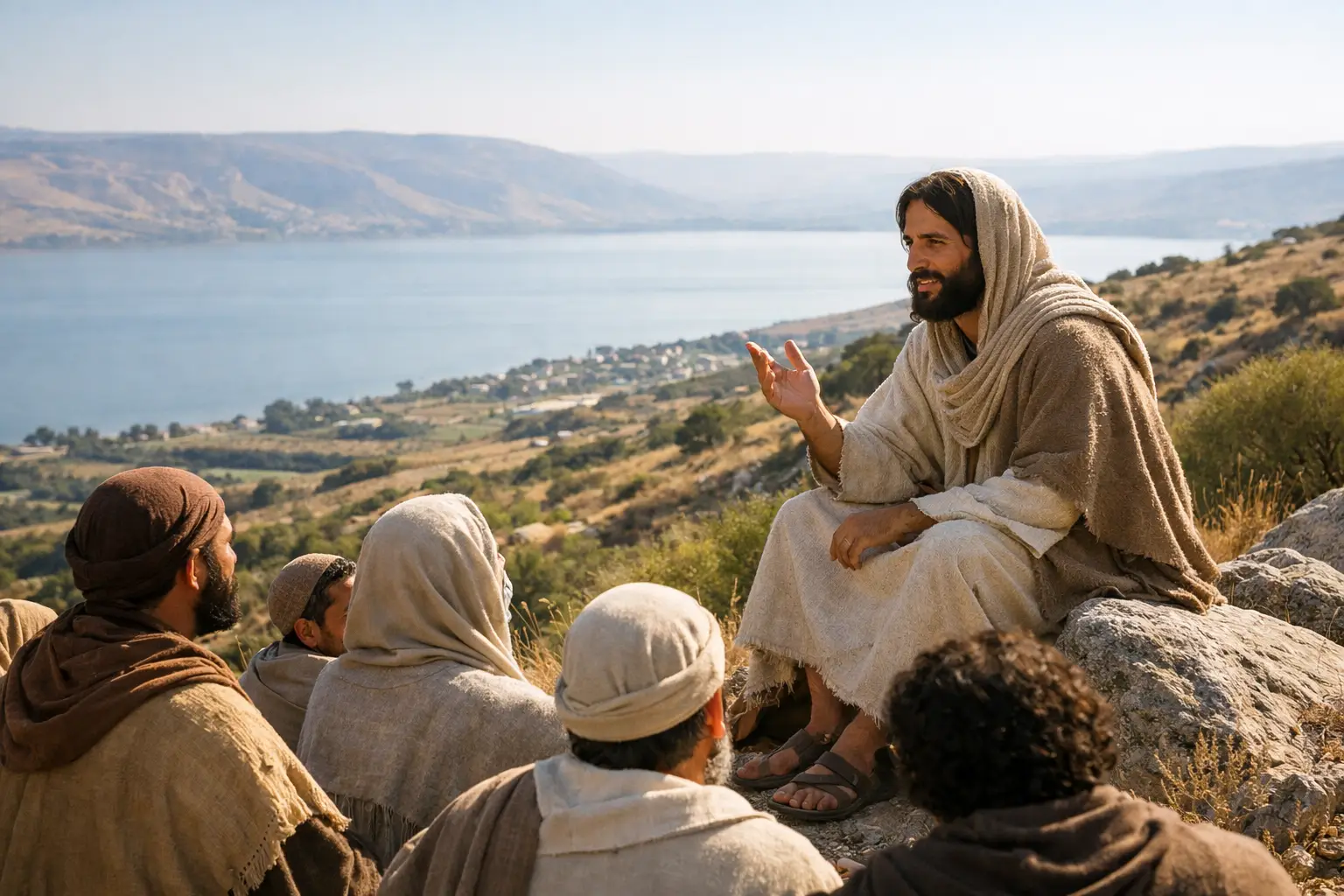
Jesus did not deliver the Sermon on the Mount merely to give His followers memorable sayings. In this guide to the Sermon on the Mount, we encounter the King describing the life of His kingdom: a life marked by humility, righteousness, mercy, prayer, trust, and obedience. Recorded in Matthew 5-7, these words call every reader to look beyond outward religion and receive the transforming rule of Christ in the heart.
Read the Sermon as Jesus’ Kingdom Teaching
Matthew introduces the setting simply: Jesus sees the crowds, goes up on the mountain, and teaches His disciples (Matthew 5:1-2). The crowds are present, but Jesus is forming those who will follow Him. His message is public enough to be heard by many and personal enough to confront each listener.
The sermon begins after Jesus has announced, “Repent, for the kingdom of heaven is at hand” (Matthew 4:17). That context matters. The Sermon on the Mount is not a detached collection of moral ideals. It reveals what life looks like under God’s reign, made possible through the King who calls people to Himself.
Some readers approach these chapters as a checklist for earning acceptance with God. Others treat the standards as so lofty that they have little connection to ordinary life. Neither response does justice to Jesus’ words. He exposes our need for grace, calls us to wholehearted obedience, and teaches His disciples how grace reshapes everyday conduct.
Begin With the Beatitudes
The Beatitudes, found in Matthew 5:3-12, set the tone for everything that follows. Jesus calls blessed the poor in spirit, those who mourn, the meek, those who hunger and thirst for righteousness, the merciful, the pure in heart, the peacemakers, and those persecuted for righteousness’ sake.
These blessings overturn common measures of success. Jesus does not praise spiritual self-sufficiency, personal power, or public approval. He blesses those who recognize their need before God and who long for His righteousness. To be poor in spirit is not to think lightly of oneself for its own sake. It is to know that we come to God empty-handed and dependent on His mercy.
The Beatitudes also keep the sermon from becoming harsh moralism. The kingdom belongs to people who know they need God. Jesus’ call to purity, reconciliation, truthfulness, and love grows from that humble dependence.
A character shaped by God’s promises
Notice that Jesus joins present grace with future hope. “Theirs is the kingdom of heaven,” He says of the poor in spirit and the persecuted. Others “will be comforted,” “will inherit the earth,” and “will see God.” Christian obedience is never separated from the promises of God. We pursue righteousness because the Father is faithful, even when faithfulness is costly.
Jesus Fulfills the Law and Searches the Heart
In Matthew 5:17, Jesus says, “I have not come to abolish them but to fulfill them.” He does not dismiss the Law and the Prophets. He brings them to their intended fulfillment and reveals their deepest purpose in God’s redemptive plan.
This is essential for reading the next section. Six times Jesus contrasts what His hearers have heard with His own authoritative teaching: “But I say to you.” He addresses murder and anger, adultery and lust, divorce, oaths, retaliation, and love for enemies. Jesus is not lowering God’s standard to manageable behavior. He brings it to the level of the heart.
Anger that despises another person, lust that turns a neighbor into an object, and deceptive speech that hides behind elaborate promises all reveal the same problem: sin is not only external. It rises from within us. Jesus’ words leave no room for self-righteous comparison.
At the same time, His teaching gives practical direction. Reconciliation should be pursued urgently. Marriage should be honored faithfully. Words should be truthful enough that a simple yes or no carries weight. Love should extend beyond those who love us in return.
Jesus’ command to love enemies is especially searching: “Pray for those who persecute you” (Matthew 5:44). This does not mean calling evil good or abandoning wise boundaries. Scripture recognizes justice, protection of the vulnerable, and honest naming of wrongdoing. But followers of Jesus must not cultivate revenge. We pray for enemies because our Father is merciful, and we remember that we ourselves have received mercy.
Practice Righteousness Before the Father
Matthew 6 turns from visible relationships to hidden devotion. Jesus speaks about giving, praying, and fasting, warning against practicing righteousness “in order to be seen by them” (Matthew 6:1). The issue is not whether others ever see our good works. Earlier, Jesus tells His disciples to let their light shine before others. The difference is the audience we seek. Are we serving God, or building an image of ourselves?
Jesus then gives the pattern commonly called the Lord’s Prayer. It begins with God: “Our Father in heaven, hallowed be your name.” Before asking for daily bread, forgiveness, and deliverance from temptation, we are taught to desire the Father’s name, kingdom, and will.
Prayer in the Sermon on the Mount is neither performance nor a way to control God. It is the trusting approach of children to their Father. Jesus tells His disciples that the Father knows what they need before they ask Him (Matthew 6:8). That knowledge does not make prayer unnecessary. It makes prayer secure.
Jesus also addresses money and anxiety with unusual directness. “Where your treasure is, there your heart will be also” (Matthew 6:21). Material possessions are not presented as evil in themselves, but they make a poor master. We cannot serve God and money. The question is not simply how much we own, but what our possessions, ambitions, and fears are asking us to trust.
When Jesus says, “Do not be anxious,” He is not rebuking suffering people for every troubled feeling. He directs anxious hearts to the Father’s care. Birds are fed; flowers are clothed; human beings are of far greater value to God. His command is clear: “Seek first the kingdom of God and his righteousness” (Matthew 6:33). Trust does not eliminate responsible work or wise planning. It does free us from living as though everything depends on our control.
A Guide to the Sermon on the Mount in Relationships
Matthew 7 begins with the familiar words, “Judge not, that you be not judged.” Jesus is not forbidding moral discernment. Later in the chapter, He warns about false prophets and tells His disciples to recognize them by their fruit. Rather, He forbids the proud, hypocritical judgment that eagerly finds a speck in another person’s eye while ignoring the log in one’s own.
The order Jesus gives is humbling: first remove the log from your own eye, then you will see clearly to help your brother. Christian correction is not canceled, but it must be governed by repentance, clarity, and love. The aim is restoration, not superiority.
Jesus follows this with an invitation: ask, seek, and knock. The Father gives good gifts to His children. Then comes the Golden Rule: “Whatever you wish that others would do to you, do also to them” (Matthew 7:12). This is active love. It asks more than, “Have I avoided harming someone?” It asks, “What faithful good should I do for this person?”
Take Jesus’ Final Warning Seriously
The sermon closes with a series of choices: the narrow gate and the broad way, true and false prophets, genuine and empty professions, rock and sand. Jesus does not allow His listeners to remain neutral observers of His teaching.
The most sobering picture is the house built on sand. The person hears Jesus’ words but does not do them. When rain, floods, and winds come, the house falls. The house built on rock belongs to the one who hears Jesus’ words and does them (Matthew 7:24-27).
Obedience is not a substitute for faith in Christ. It is the fruit of hearing Him rightly. A disciple does not merely admire the Sermon on the Mount, quote it selectively, or use it to measure everyone else. A disciple comes to Jesus, receives His mercy, and orders life around His words.
Read, Pray, and Obey One Section at a Time
A helpful way to study these chapters is to read a short section slowly, beginning with the question, “What is Jesus teaching here?” Then ask, “What does this reveal about the Father, the kingdom, and my own heart?” Finally, bring one clear response to God in prayer.
For example, Matthew 5:23-24 may lead you to seek reconciliation. Matthew 6:9-13 may reshape the way you pray this week. Matthew 6:25-34 may expose a worry you need to place before the Father. Matthew 7:1-5 may call you to repent of a critical spirit before addressing another person’s fault.
The Sermon on the Mount is not a distant standard reserved for Bible classrooms. These are the words of Jesus for His people. Return to Matthew 5-7 often, ask the Holy Spirit to make Christ’s teaching plain, and take the next faithful step of obedience before you.