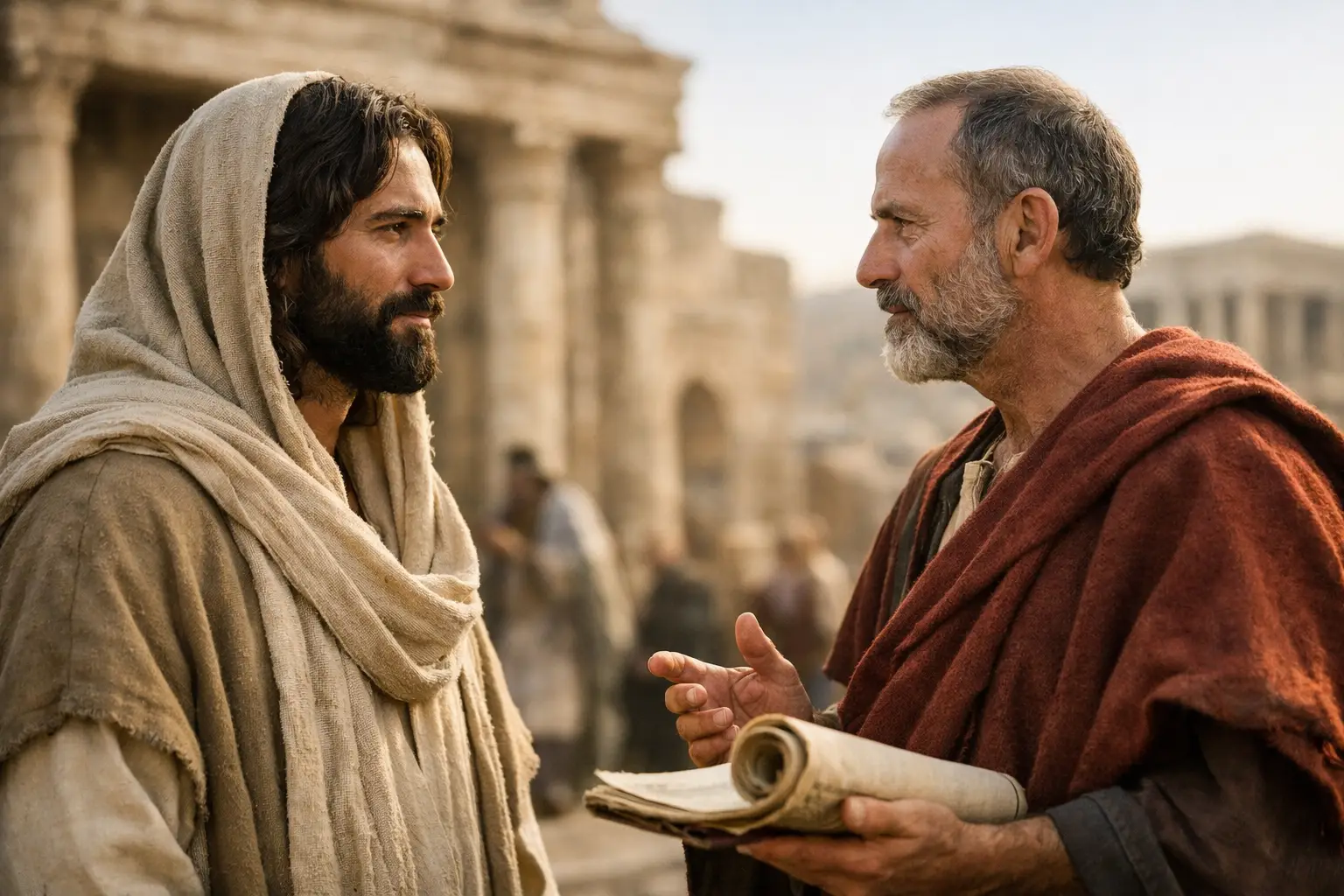
The question often arrives with real concern: If Jesus taught one thing in the Gospels and Paul wrote something that sounds different in his letters, whom should a Christian follow? The teachings of jesus vs paul should not be treated as a contest between two competing authorities. Jesus is the risen Lord, and Paul is His chosen apostle, called to proclaim the gospel of Christ and help the early churches live faithfully under His lordship.
Still, the question is worth asking carefully. Christians should never allow familiar theological phrases, debates, or isolated verses to overshadow the direct words of Jesus. At the same time, we should not dismiss Paul, whose letters are part of the Spirit-inspired witness that explains the meaning and implications of Christ’s saving work. A faithful reading begins with Jesus and reads Paul in light of Jesus.
Teachings of Jesus vs Paul: Not a Rivalry
Jesus spoke and acted with a unique authority. He did not merely offer religious commentary. He called people to repent, announced the kingdom of God, forgave sins, revealed the Father, died for sinners, and rose again. In the Great Commission, Jesus told His disciples to make disciples and teach them “to observe all that I have commanded you” (Matthew 28:20). His commands are not optional additions to Christian faith. They belong at the center of Christian discipleship.
Paul recognized that authority. He did not present himself as an alternative Christ or a replacement teacher. He introduced himself as a servant and apostle of Christ Jesus. His message centered on “Jesus Christ and him crucified” (1 Corinthians 2:2), and he repeatedly directed churches to the Lord’s command. On questions about marriage, for example, Paul distinguished between what “the Lord” had commanded and his own pastoral instruction for circumstances Jesus had not directly addressed during His earthly ministry (1 Corinthians 7:10-12, 25).
That distinction is instructive. Paul did not lower Jesus’ words. He applied the lordship of Jesus to new pastoral questions facing churches after the resurrection, Pentecost, and the spread of the gospel among the nations.
Why Their Emphases Can Sound Different
The Gospels record Jesus teaching within first-century Israel as He announced that God’s kingdom had drawn near. He spoke in parables, conversations, warnings, commands, and acts of compassion. He addressed heart-level obedience: anger, lust, hypocrisy, forgiveness, prayer, generosity, humility, love of enemies, and trust in God.
Paul wrote letters to specific congregations dealing with specific needs. Some were divided. Some were confused about grace, spiritual gifts, sexual holiness, suffering, work, leadership, or false teaching. His letters are occasional documents, written into real situations. This means a passage in Paul may answer a problem that is not directly addressed in the same form in the Gospels.
Different settings create different vocabulary, but not a different gospel. Jesus called people to follow Him, deny themselves, take up their cross, and bear fruit. Paul taught believers to live “in Christ,” walk by the Spirit, put off the old self, and present their bodies to God (Luke 9:23; John 15:1-10; Galatians 5:16-25; Romans 12:1-2). Both call for a transformed life rooted in God’s grace.
Jesus proclaimed that He came to give His life “as a ransom for many” (Mark 10:45). At the Last Supper, He spoke of His blood “poured out for many for the forgiveness of sins” (Matthew 26:28). Paul proclaimed this same saving center: Christ died for our sins, was buried, and was raised on the third day (1 Corinthians 15:3-4). Paul did not invent a gospel of the cross separate from Jesus. He preached what Jesus’ death and resurrection accomplished.
Jesus Is the Starting Point for Christian Living
There is a difference between saying all Scripture is valuable and saying every biblical statement has the same role in a believer’s daily obedience. Scripture itself gives Jesus a singular place. The Father commands, “Listen to him” (Matthew 17:5). Jesus says that those who love Him will keep His commands (John 14:15). He is not merely one voice among many. He is Lord.
For that reason, believers do well to begin difficult questions by asking, “What did Jesus say?” What did He teach about the character of God, the kingdom, love, sin, mercy, truth, prayer, wealth, forgiveness, marriage, enemies, and faithful obedience? His words provide the clearest center for the Christian life.
This approach does not reduce the rest of the New Testament. Rather, it gives it its proper relationship to Christ. The apostles bear witness to Him. The Old Testament prepares for Him and is fulfilled in Him. Paul helps churches understand how the gospel of Jesus shapes life in the Spirit. When Christians read Scripture this way, they are less likely to use a verse as a weapon against Jesus’ own teaching or to treat grace as permission for disobedience.
Jesus Himself warned against hearing without doing. At the close of the Sermon on the Mount, He compared the person who hears His words and does them to a wise man building on rock (Matthew 7:24-27). Paul gives the same practical direction when he writes that faith should work through love (Galatians 5:6). Grace does not cancel obedience. Grace forms a people who obey from faith, gratitude, and love rather than self-righteousness.
Apparent Tensions Need Careful Reading
Some readers see a conflict between Jesus’ call to obedience and Paul’s teaching that a person is justified by faith apart from works of the law (Romans 3:28). But the conflict often disappears when the question is defined correctly.
Jesus condemned religious performance that looked impressive while the heart remained far from God. He rebuked those who neglected justice, mercy, and faithfulness while focusing on outward appearances (Matthew 23:23). Paul likewise rejected boasting in human effort and insisted that no one can earn reconciliation with God. Both oppose the attempt to establish one’s own righteousness before God.
Neither Jesus nor Paul teaches that genuine faith leaves a person unchanged. Jesus said a good tree bears good fruit (Matthew 7:17). Paul taught that believers are created in Christ Jesus for good works (Ephesians 2:10). The order matters: we are saved by God’s grace, not by our merit; yet the grace that saves also calls and empowers us to live differently.
Another concern involves the law. Jesus said He did not come to abolish the Law or the Prophets but to fulfill them (Matthew 5:17). Paul explains that Christ is the culmination of the law for righteousness to everyone who believes (Romans 10:4). Jesus reveals the law’s deepest purpose by bringing it to fulfillment and by calling for righteousness from the heart. Paul explains how Jews and Gentiles alike belong to God’s people through faith in Christ, not through ethnic boundary markers or reliance on law-keeping for justification.
The details can be challenging, and Christians may differ on some applications. But we should resist quick claims that Jesus taught one religion and Paul another. Such claims usually overlook the whole biblical story and the apostolic witness to the risen Christ.
How to Read Jesus and Paul Faithfully
A healthy practice is to read a Gospel steadily, paying close attention to Jesus’ actual words, questions, commands, promises, and warnings. Notice what He repeatedly emphasizes. Then read Paul’s letters as pastoral instruction for people who belong to the same Jesus.
When a passage seems difficult, ask a few simple questions. What was Jesus’ teaching in its original setting? What situation is Paul addressing? Does Paul echo, explain, or apply something Jesus taught? How does the cross and resurrection clarify the issue? These questions slow us down and protect us from building major conclusions on a single verse.
It also helps to remember that Christian obedience is relational. Jesus does not call people merely to adopt an ethical system. He calls them to Himself: “Follow me.” Paul echoes that personal reality when he speaks of life in Christ. The goal is not to choose a favorite biblical writer. The goal is to know, trust, and obey the Lord whom the apostles faithfully proclaimed.
Let the Words of Jesus Lead You
The teachings of Jesus vs Paul become clearer when Jesus is allowed to remain at the center. Read His words first. Receive Paul’s letters as God-given instruction that points to Christ, proclaims His saving work, and equips His people for faithful living.
Take time this week to read one chapter from a Gospel and ask one honest question: What is Jesus asking of me here? Then carry that question into the rest of Scripture. At JesusSaid.tv, that is the kind of study we want to encourage – not argument for its own sake, but a deeper, lived obedience to the One who said, “If you love me, you will keep my commandments.”