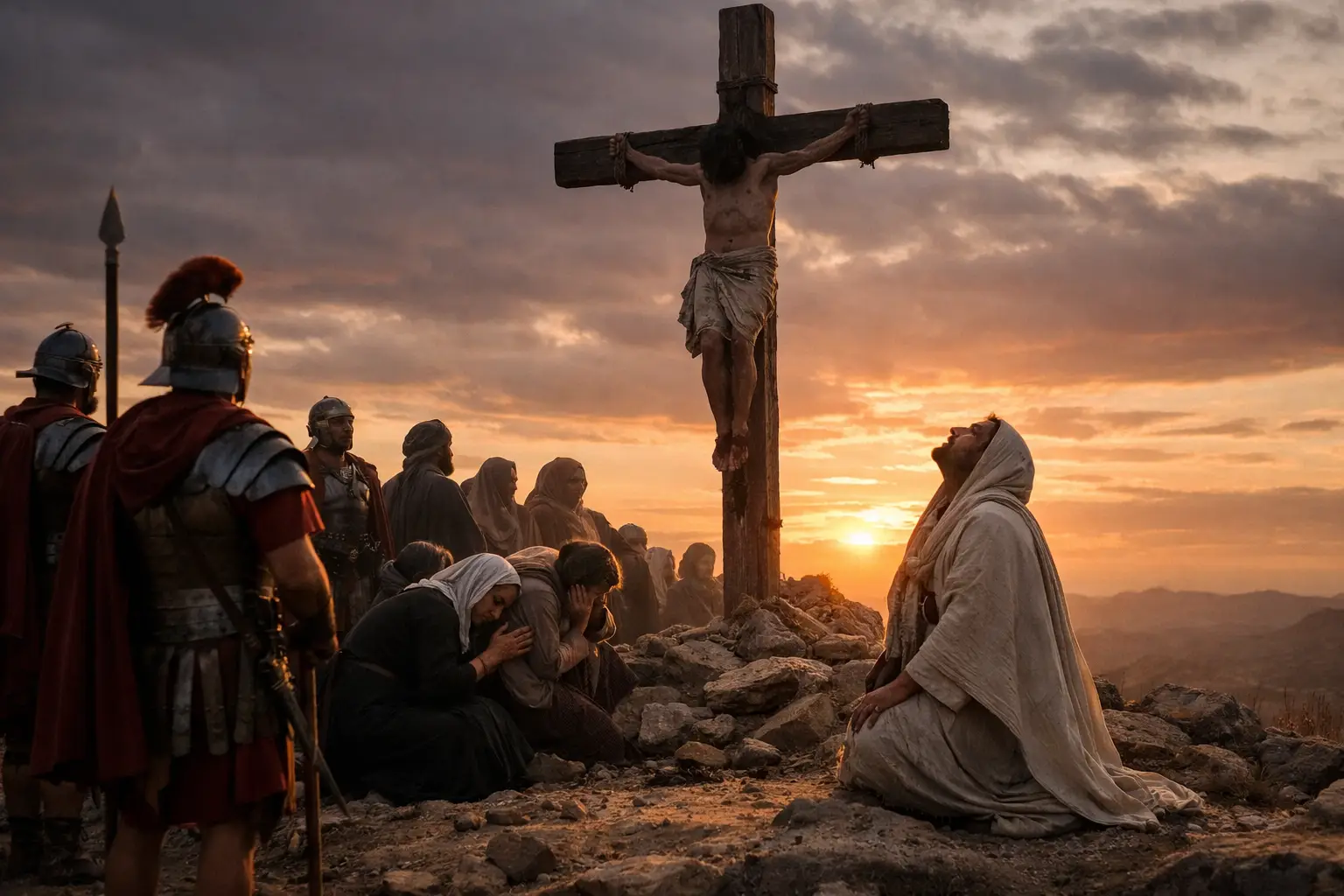
If you have ever asked, what was Jesus last word, you are not alone. It is a simple question, but when we open the Gospels carefully, we find that Scripture gives us more than a single word. It gives us the final recorded sayings of Jesus on the cross, and together they reveal His trust in the Father, His finished work, and His heart even in suffering.
What was Jesus last word according to the Gospels?
The short answer depends on which Gospel account you are reading.
Luke records Jesus saying, “Father, into Your hands I commit My spirit” (Luke 23:46). Then Luke says He breathed His last. John records Jesus saying, “It is finished” (John 19:30), and then He bowed His head and gave up His spirit.
So which one was last?
Faithful readers have long recognized that the Gospels are not contradicting one another. They are giving complementary testimony. Each writer, guided by the Holy Spirit, highlights what serves his purpose in presenting Jesus truthfully. John emphasizes the completion of Christ’s mission. Luke emphasizes Jesus’ final act of trust and surrender to the Father.
If we are asking for the final saying just before death in sequence, many Christians understand Luke 23:46 to be the final spoken words: “Father, into Your hands I commit My spirit.” If we are asking for the climactic declaration that His redeeming work had reached completion, John gives us “It is finished.”
That is why reducing the moment to one isolated word can miss the weight of what Scripture is showing us.
The seven last sayings help answer the question
Christians often speak of the “seven last sayings” of Jesus from the cross. These are drawn from all four Gospels and give a fuller picture of His final hours.
Jesus said, “Father, forgive them, for they do not know what they do.” He said to the repentant criminal, “Today you will be with Me in Paradise.” He said to His mother and to John, “Woman, behold your son,” and “Behold your mother.” He cried, “My God, My God, why have You forsaken Me?” He said, “I thirst.” He declared, “It is finished.” And finally, “Father, into Your hands I commit My spirit.”
When people ask what was Jesus last word, they are usually trying to identify the final line before death. But Scripture invites us to consider all of these sayings together. They are not random fragments. They show forgiveness, salvation, compassion, anguish, fulfillment, victory, and trust.
Why John says “It is finished”
John 19:30 is one of the most powerful statements in all of Scripture: “It is finished.” Jesus was not saying that His life ended in defeat. He was announcing that the work the Father gave Him to do had been brought to completion.
Throughout John’s Gospel, Jesus speaks of being sent by the Father and doing the Father’s will. His death was not an accident of history or a tragic collapse of His mission. It was the very reason He came. He laid down His life willingly.
When He said, “It is finished,” He declared that the work of atonement had reached its appointed goal. The sacrifices, promises, and shadows of the Old Testament were finding their fulfillment in Him. Sin was being dealt with. The obedient Son had gone all the way to the cross.
For believers, those words matter deeply. Jesus did not say, “I am finished.” He said, “It is finished.” His mission was accomplished.
Why Luke records “Father, into Your hands I commit My spirit”
Luke 23:46 presents Jesus’ final words as a prayer drawn from Psalm 31:5. Even in death, Jesus speaks to the Father with confidence. He is not overcome by chaos. He entrusts Himself fully into the Father’s hands.
This matters because it shows both His humanity and His unwavering faith. Jesus truly suffered. He truly died. Yet His final breath was not despairing surrender to circumstances. It was conscious trust in the Father.
Luke’s wording also reminds us that Jesus’ life was not taken from Him against His will. He gave up His spirit. This agrees with what Jesus taught earlier in John 10, that no one took His life from Him, but He laid it down of Himself.
So if someone asks, “What were the last spoken words of Jesus before He died?” Luke gives the most direct answer: “Father, into Your hands I commit My spirit.”
Is there a contradiction between John and Luke?
There is no need to force a contradiction where the text does not require one. The Gospels often present selected details rather than exhaustive transcripts. In ordinary life, if several witnesses recount a person’s final moments and one includes one sentence while another includes a different sentence, that does not prove conflict. It may simply mean each witness preserves part of the whole.
A reasonable reading is that Jesus said both. He could have declared, “It is finished,” and then prayed, “Father, into Your hands I commit My spirit.” John highlights the completion of the work. Luke highlights the final entrusting of His spirit to the Father.
That reading fits the flow of both accounts and preserves the full force of each statement.
What was Jesus last word, singular or plural?
Sometimes the question is framed too narrowly. In English, people often say “last word” when they really mean “last statement.” Strictly speaking, Luke and John both record full sentences, not one isolated word.
If someone presses the question down to a single final word in English, the answer would depend on the translation. In Luke 23:46, the final word is often translated “spirit.” In John 19:30, the final word may be “finished” in the phrase “It is finished.” But that kind of word-by-word approach usually creates more confusion than clarity.
The better question is, what did Jesus say in His final moments? Scripture answers that with rich and purposeful detail.
What His last words reveal about Jesus
Jesus’ last words on the cross are not merely historical details. They teach us who He is.
They reveal His obedience. He completed the work the Father gave Him.
They reveal His authority. He gave up His spirit willingly.
They reveal His trust. He committed Himself into the Father’s hands.
They reveal His mercy. Even from the cross, He prayed for forgiveness and promised Paradise to a repentant sinner.
They reveal that the cross was central, not secondary, to His mission. Jesus did not simply teach truth. He gave Himself for sinners.
For Christians, this means our confidence rests not in our performance but in His finished work. For seekers, it means the cross is not only a symbol of suffering but the place where God’s love and justice meet in Christ.
Why this question matters for Bible study
Questions like what was Jesus last word can become unhelpful if we are only chasing trivia. But they become very fruitful when they lead us back to the text itself.
This is one reason careful Bible study matters. We do not need to choose between one Gospel and another. We need to listen to all that Scripture says. When we do, the picture becomes fuller, not weaker.
JesusSaid.tv exists to help people do exactly that: begin with the words of Jesus, then understand how the rest of Scripture supports and illuminates them. In this case, the final sayings of Christ lead us to the heart of the gospel itself.
The strongest biblical answer
If you want the most direct response, you can say this: the final recorded words of Jesus before His death were, “Father, into Your hands I commit My spirit” in Luke 23:46. John also records the climactic declaration, “It is finished,” which announces the completion of His redemptive work.
Both matter. One tells us that the work was completed. The other shows us the Son entrusting Himself to the Father.
When we hear those words together, we do not just get an answer to a question. We are brought to the foot of the cross, where Jesus finished the work He came to do and entrusted His spirit to the Father with perfect confidence.
If you want to keep studying this passage, read the crucifixion accounts side by side in Matthew 27, Mark 15, Luke 23, and John 19, and pay close attention to what Jesus actually said. His words are never incidental, and His final words are no exception.