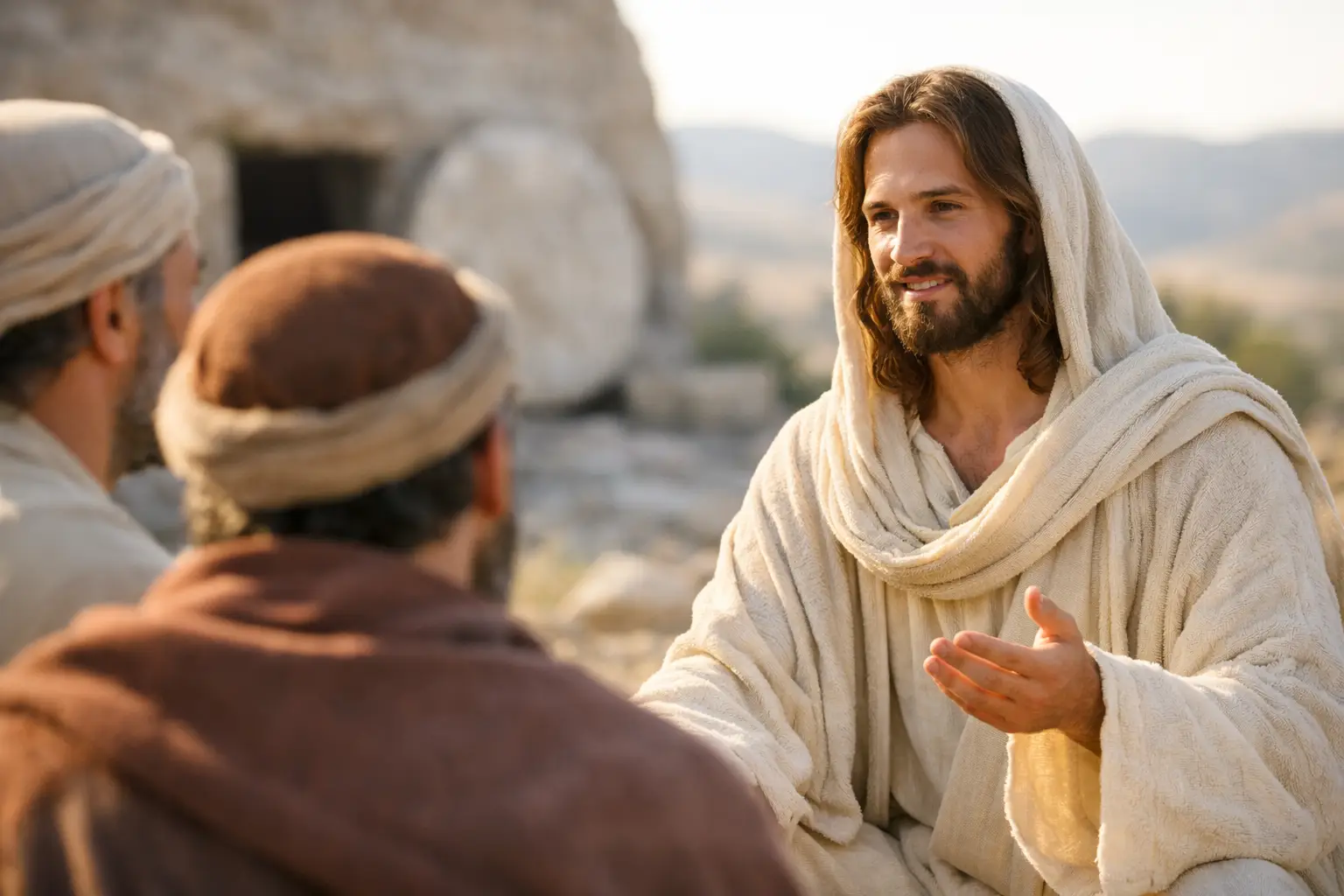
The words of Jesus after resurrection deserve careful attention because they were spoken in the days between the empty tomb and His ascension. These were not casual remarks. They came from the risen Lord, spoken to fearful disciples, grieving followers, doubting hearts, and future witnesses. If we want to understand what Jesus wanted firmly planted in His followers after His victory over death, these passages matter deeply.
Some believers spend much time on the cross and the resurrection morning, and rightly so. But the forty days that followed are also full of instruction. Jesus did not rise only to prove a point. He rose and then spoke. His words brought peace, corrected unbelief, opened Scripture, restored a fallen disciple, and commissioned His people for the work ahead.
Why the words of Jesus after resurrection matter
The setting gives these sayings unusual weight. The disciples had failed, scattered, and struggled to believe the reports they received. Jesus met them in that weakness. What He said after rising from the dead shows us what He considered essential for a frightened and unfinished people.
These words also help us read the rest of the New Testament properly. The book of Acts and the apostolic letters do not move away from Jesus. They carry forward what the risen Christ taught. That matters for any Christian who wants to keep the words of Jesus at the center while also honoring the full witness of Scripture.
There is also a pastoral tenderness in these moments. The risen Jesus does not first greet His disciples with rejection. He comes speaking peace. He does not ignore sin or failure, but He addresses His followers in a way that restores, instructs, and sends them.
Peace, not panic
One of the first repeated themes in the words of Jesus after resurrection is peace. In John 20, Jesus came into the room where the disciples were gathered behind closed doors and said, “Peace be unto you.” He says it again. That repetition is worth noticing.
This was more than a polite greeting. The disciples were afraid. They had seen Jesus crucified, and now they were uncertain what came next. His first word to them was not, “Why did you run?” It was peace. The risen Christ stood among troubled people and settled them with His presence and His voice.
That still speaks clearly today. Christ’s peace is not denial of danger. The disciples were still living in a hostile world. Rather, His peace was the assurance that His death and resurrection had changed everything. Because He lives, fear no longer has the final word.
Faith for those who struggle to believe
Thomas often receives harsh treatment, but Jesus dealt with him patiently. When Thomas said he would not believe unless he saw and touched the wounds of Jesus, the Lord later appeared and invited him to do exactly that. Then Jesus said, “Be not faithless, but believing” and, “Blessed are they that have not seen, and yet have believed.”
That exchange is important because it speaks to both doubt and faith. Jesus did not praise unbelief, but neither did He cast Thomas away. He confronted his hesitation and called him to faith. Thomas responded with one of the clearest confessions in Scripture: “My Lord and my God.”
For readers today, this is deeply relevant. Most believers have not seen Jesus with physical eyes. Yet Jesus Himself pronounced a blessing on those who believe on the basis of truthful witness. Christian faith is not blind faith. It rests on the testimony of those who saw the risen Christ and on the trustworthy Word of God.
The risen Jesus opened the Scriptures
On the road to Emmaus, two disciples were confused and downcast. Jesus joined them, though they did not recognize Him at first, and addressed not only their sadness but their understanding. He said, “O fools, and slow of heart to believe all that the prophets have spoken.” Then, beginning with Moses and all the prophets, He explained the things concerning Himself in all the Scriptures.
Later, in Luke 24, He told the gathered disciples that all things written in the Law of Moses, the Prophets, and the Psalms concerning Him must be fulfilled. Then He opened their understanding so they might understand the Scriptures.
This matters because the risen Jesus taught His followers how to read the Bible. He did not treat His death and resurrection as isolated events. He showed that they stood in fulfillment of God’s long-promised plan. For the church, that means we should read all Scripture in a Christ-centered way, not by forcing meanings into texts, but by following the pattern Jesus Himself gave.
It also means ignorance of Scripture leaves believers vulnerable to confusion. These disciples were sincere, but sincerity alone was not enough. They needed their minds opened by the Lord’s teaching.
Repentance and forgiveness must be preached
Among the clearest resurrection teachings of Jesus is His commission concerning the message itself. In Luke 24 He says that repentance and remission of sins should be preached in His name among all nations, beginning at Jerusalem.
That sentence is simple, but it guards the church from drift. The mission of God’s people is not merely moral improvement, cultural influence, or religious activity. The risen Christ says the message is repentance and forgiveness in His name.
These two belong together. Repentance without forgiveness leads to despair. Forgiveness without repentance turns grace into sentiment. Jesus holds both together. He calls sinners to turn, and He offers real pardon on the basis of what He has accomplished.
This is one reason the words of Jesus after resurrection remain urgent. They tell us not only that we are sent, but what we are sent to say.
As the Father sent Me, so send I you
In John 20, Jesus tells the disciples, “As my Father hath sent me, even so send I you.” This is a staggering statement. It does not mean the disciples repeat His atoning work. Only Christ could die for sin and rise again in victory. But it does mean His followers are sent into the world under divine commission.
The pattern matters. Jesus was sent in truth, holiness, compassion, and obedience to the Father. His people are sent in that same posture. Christian mission is not self-appointed. It begins with the authority of the risen Jesus.
He then breathed on them and spoke about the Holy Spirit, showing that His mission would not be carried out by human energy alone. There are details in this passage that faithful Christians discuss carefully, especially in relation to Pentecost and the later outpouring of the Spirit in Acts 2. But the central point is plain enough: Jesus never intended His followers to serve Him in their own strength.
Feed My sheep
Perhaps the most personal of the resurrection conversations is Jesus’ restoration of Peter in John 21. Peter had denied the Lord three times. After the resurrection, Jesus asked him three times, “Lovest thou me?” Each time, Jesus joined Peter’s love for Him with a pastoral charge: “Feed my lambs,” “Feed my sheep.”
This moment shows that love for Jesus and care for His people cannot be separated. The risen Christ did not restore Peter merely to private peace. He restored him to faithful service. Shepherding Christ’s people would require tenderness, truth, and sacrifice.
There is a lesson here for every believer, and especially for pastors and ministry leaders. The work of serving others must flow from genuine love for Jesus. Activity without devotion becomes hollow. On the other hand, true love for Christ will express itself in obedience and care for the people He calls His own.
Jesus also told Peter that following Him would be costly. Resurrection joy does not cancel the call to take up the cross. The risen Lord still leads His servants in the path of obedience, even when that path includes suffering.
Go into all the world
The Great Commission, recorded in varying but harmonious ways in Matthew, Mark, Luke, John, and Acts, stands at the center of Jesus’ post-resurrection words. He declared that all authority in heaven and earth had been given to Him. On that basis, His followers were commanded to make disciples of all nations, baptize them, and teach them to observe all things He had commanded.
That final phrase is especially important for a ministry committed to the teachings of Christ. The mission is not only to win decisions, gather crowds, or create religious interest. It is to make disciples who obey Jesus.
Notice the balance. The commission is global, but it is also deeply practical. It reaches all nations, yet it comes down to teaching people to obey what Jesus said. Breadth and depth belong together.
Jesus also promised His presence: “Lo, I am with you always, even unto the end of the world.” The One who sends is the One who remains with His people. That promise keeps the church from despair and from pride. We are neither abandoned nor self-sufficient.
How these words shape believers now
The words of Jesus after resurrection still form the church today. They teach us to receive His peace in fearful times, to move from doubt toward faith, to read Scripture with Christ at the center, to preach repentance and forgiveness, to serve in the power of the Spirit, to care for His people, and to make disciples under His authority.
They also remind us that the risen Jesus is not silent. His resurrection was not only an event to celebrate but a reality from which He still instructs His people through the witness of Scripture. If we want to know what matters most after the empty tomb, we should listen carefully to what He said next.
That is a worthy place to continue your study. Open the Gospel accounts and read those post-resurrection passages slowly. Let the risen Christ speak for Himself, and you will find that His words still bring peace, clarity, and direction to those who follow Him.