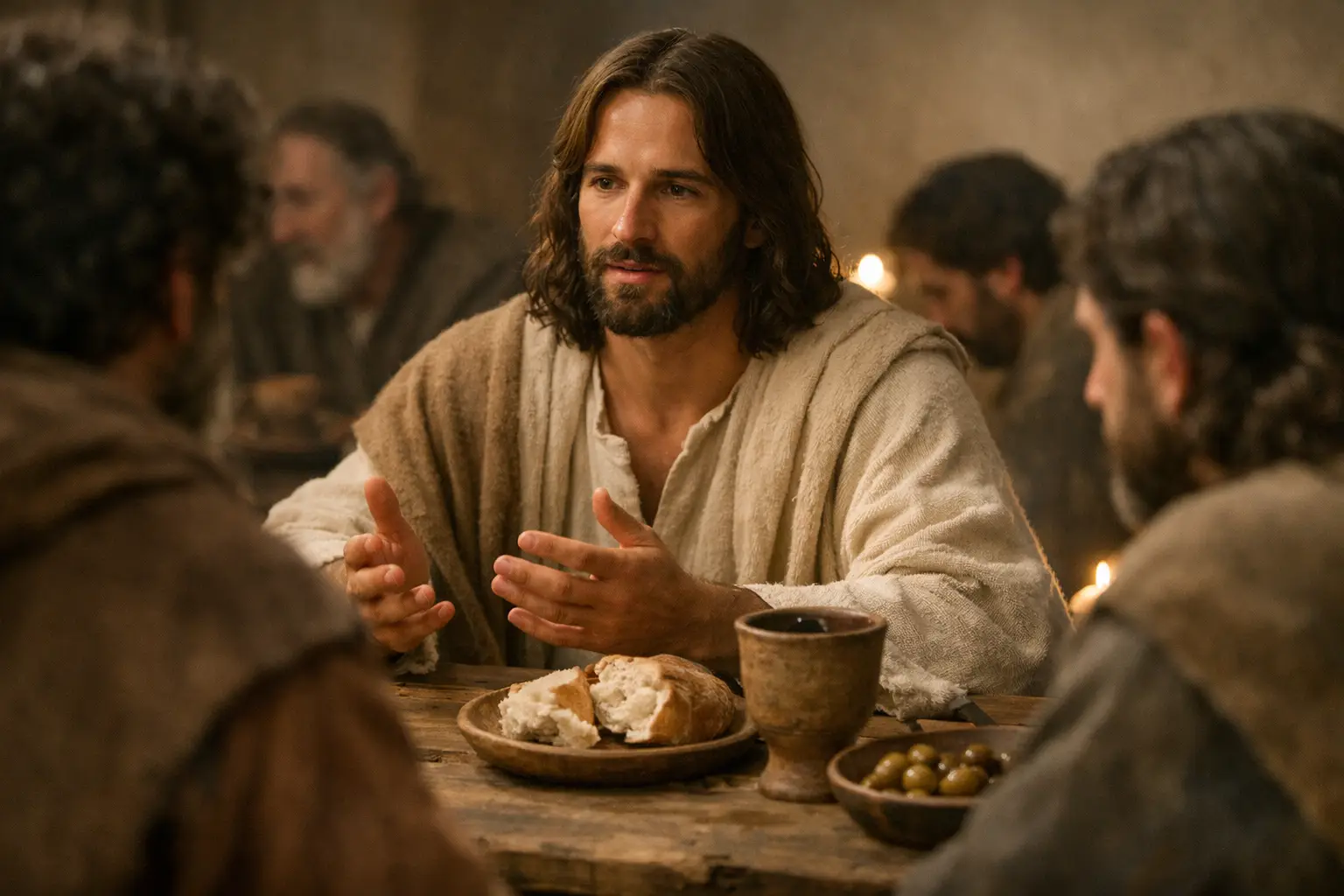
The room was quiet enough for a troubled heart to be heard. Before the arrest, before the trial, before the cross, Jesus sat with His disciples and spoke some of the most weighty words recorded in Scripture. When we study the words of Jesus at the Last Supper, we are not reading passing comments at the end of a meal. We are hearing the Lord prepare His followers for His death, His departure, and their future life in Him.
The Last Supper appears in Matthew 26, Mark 14, Luke 22, and reaches its fullest teaching form in John 13 through 17. Taken together, these passages show that Jesus was not merely observing Passover with His disciples. He was revealing the meaning of His death, exposing the reality of betrayal, giving a new commandment, and directing His people toward faithful obedience.
Why the words of Jesus at the Last Supper matter
These sayings matter because Jesus spoke them at a turning point. The cross was only hours away. If we want to understand what was central on His heart for His disciples, this meal gives us a clear answer.
He spoke about humility before greatness. He spoke about His body and blood before the crucifixion happened. He spoke about love before fear scattered the disciples. He spoke about the Holy Spirit before His visible presence was taken from them. And He spoke about abiding in Him before they faced suffering in the world.
That alone should slow us down. The words of Jesus at the Last Supper are not detached theology. They are pastoral, urgent, and deeply personal.
The setting of the Last Supper
The meal itself was connected to Passover, the great remembrance of God’s deliverance of Israel from Egypt. In that setting, Jesus gave new meaning to the bread and cup. He took an existing covenant meal and showed that it pointed to Him.
Luke records Jesus saying, “With fervent desire I have desired to eat this Passover with you before I suffer” (Luke 22:15). That statement tells us something important. Jesus was not caught in events beyond His control. He knew what was coming, and He intentionally gathered His disciples for this final meal.
John’s Gospel adds another striking detail. Before speaking many of His farewell words, Jesus washed the disciples’ feet. The One who is Lord took the place of a servant. That act helps interpret the rest of the evening. Everything Jesus said was framed by holy love and humble service.
What did Jesus say at the Last Supper?
Several statements stand at the center of the evening.
First, Jesus spoke about betrayal. He said, “One of you will betray Me” (Matthew 26:21). This was not only a revelation of Judas. It was a reminder that sin can exist close to sacred things. A man could sit at the table with Jesus and still harden his heart. That is a sobering warning for every generation.
Second, Jesus spoke over the bread and cup. “Take, eat; this is My body” and “Drink from it, all of you. For this is My blood of the new covenant, which is shed for many for the remission of sins” (Matthew 26:26-28). Here Jesus interpreted His coming death. He would not die merely as a victim of injustice. He would give Himself sacrificially for sinners.
Third, He spoke about greatness and service. In Luke 22, while the disciples argued about who was greatest, Jesus answered that the greatest should be like the younger and the leader like one who serves. Then He pointed to Himself: “I am among you as the One who serves” (Luke 22:27). In a single evening, Jesus corrected ambition and redefined leadership.
Fourth, He gave what John records as a new commandment: “Love one another; as I have loved you” (John 13:34). The command to love was not entirely new in Scripture, but the measure of that love was now seen in Christ Himself. They were to love one another with a love shaped by His example, His sacrifice, and His truth.
Fifth, He comforted them about His departure. “Let not your heart be troubled” (John 14:1). He was leaving, yet He was not abandoning them. He promised a place prepared for His people and declared, “I am the way, the truth, and the life” (John 14:6). In a moment filled with confusion, Jesus directed their faith toward His person.
Sixth, He promised the Holy Spirit. Jesus told them that the Helper would come, teach them, bring His words to remembrance, and testify of Him. This matters because the Christian life was never meant to be lived by human strength alone. The disciples would need divine help to remember, obey, and witness.
Seventh, He called them to abide in Him. In John 15, Jesus said, “I am the vine, you are the branches.” Fruitfulness would not come from self-effort separated from Christ. It would come from remaining in Him. This teaching belongs naturally to the Last Supper conversation because Jesus was preparing them for life after His physical departure.
The meaning behind the bread and the cup
Among all the words of Jesus at the Last Supper, His statements over the bread and cup receive the most attention, and rightly so. Yet Christians have sometimes focused so much on debates about the elements that they miss the plain force of His words.
Jesus was directing His disciples to remember Him through a covenant meal grounded in His sacrificial death. His body would be given. His blood would be shed. Forgiveness would come through Him. Whatever church tradition one comes from, the heart of the passage is clear: the cross is central, and Jesus gave this meal so His people would remember what His death accomplished.
Luke adds the words, “Do this in remembrance of Me” (Luke 22:19). Remembrance in Scripture is not mere mental recall. It is a faith-filled act of looking again to the saving work of God. At the Lord’s Table, believers are called to remember Christ with reverence, gratitude, and self-examination.
A new commandment in a dark hour
It is striking that Jesus gave His command to love one another on the same night He was betrayed. He did not wait for ideal conditions. He spoke about love in the presence of weakness, confusion, pride, and coming failure.
That helps us read His command honestly. Christian love is not sentimental language detached from obedience. Jesus tied love to action, sacrifice, and truth. He had just washed feet. He was about to lay down His life. Then He said, in effect, Love one another the way I have loved you.
This also means that love among believers is one of the clearest witnesses to the world. Jesus said that by this all would know they were His disciples. Not by noise, not by self-promotion, but by Christlike love.
Trouble, denial, and hope
The Last Supper was not emotionally simple. Jesus spoke of betrayal. He told Peter that Peter would deny Him. He warned the disciples of coming sorrow. There is no shallow optimism in these chapters.
Yet there is strong hope. Jesus prayed for His disciples. He promised peace unlike the world’s peace. He told them that their sorrow would turn to joy. He assured them that He had overcome the world.
That balance matters for believers today. The words of Jesus at the Last Supper do not promise an easy road. They do promise a faithful Savior. Christians may face confusion, failure, grief, and opposition, but Jesus prepares His people with truth, prayer, and peace.
How believers should respond today
These words call for more than admiration. They call for obedience.
We should come back to Christ’s own teaching when we think about communion, leadership, love, and perseverance. We should examine whether our lives reflect the servant-hearted pattern He set. We should ask whether we are abiding in Him or relying on our own strength. And we should remember that Jesus prepared His disciples not only to survive a crisis, but to remain faithful after it.
For pastors, teachers, and church leaders, the Last Supper is especially searching. Jesus joined authority with humility and truth with love. For every believer, these chapters invite a deeper walk with Christ – one marked by remembrance, obedience, and trust.
If you want to understand Jesus more clearly, stay with these final table words a little longer. Read them slowly in the Gospels. Let His command to love, His call to abide, and His promise of peace speak again with fresh weight. At JesusSaid.tv, that is where faithful study begins – with the words of Jesus Himself.