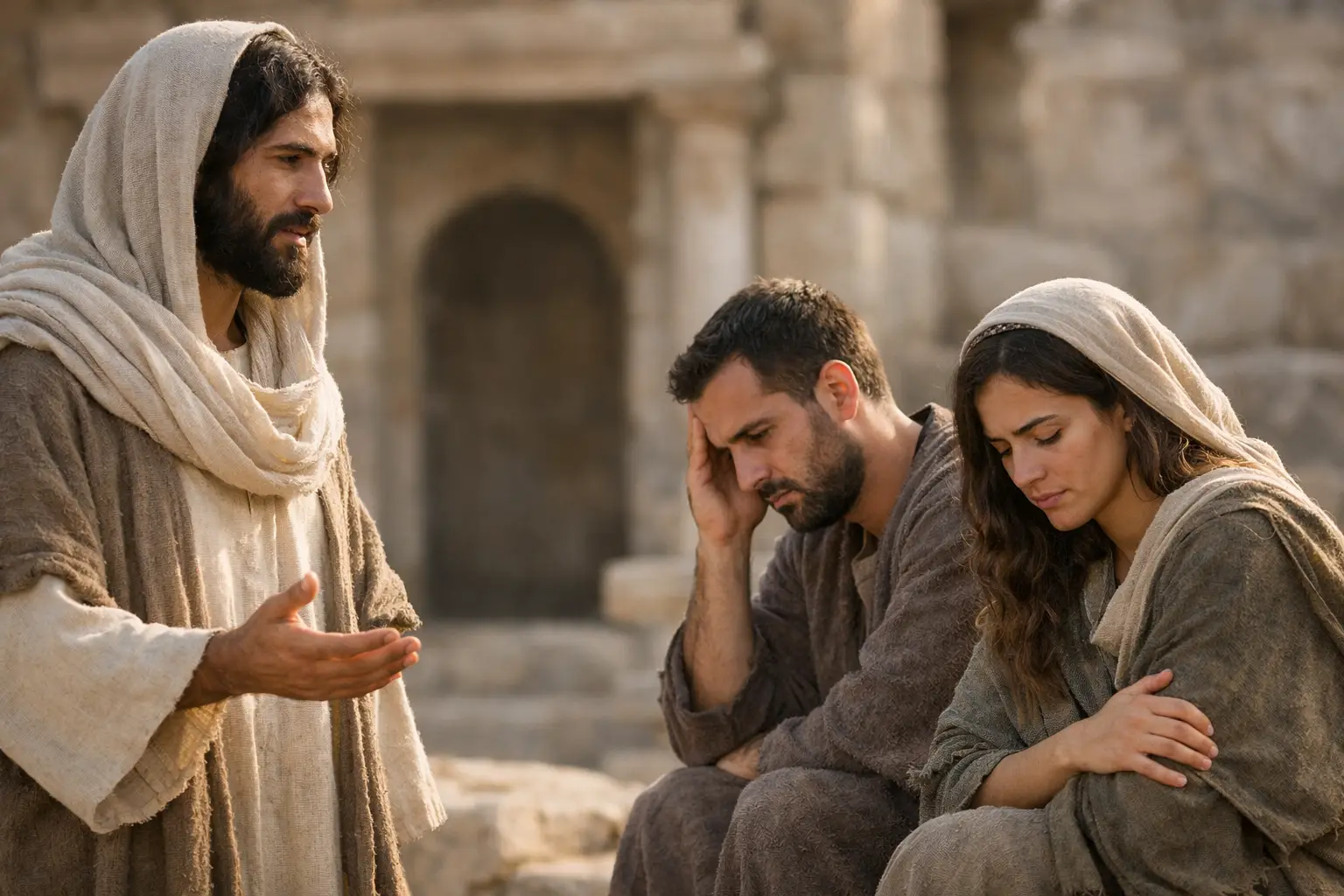
Marriage vows are often spoken in a moment of hope, but questions about divorce usually arise in places of real sorrow: broken trust, persistent conflict, abandonment, betrayal, and sometimes danger. Jesus teaching on divorce does not offer shallow answers for deep wounds. It calls us back to God’s purpose for marriage while speaking truthfully about the hardness of the human heart.
Jesus addressed divorce directly in Matthew 5:31-32, Matthew 19:3-9, and Mark 10:2-12. Because His words are weighty and personal, they deserve to be read carefully, in their setting, and with a posture of humility. The goal is not to make a difficult situation sound simple. It is to hear Christ clearly and let His teaching shape both our convictions and our compassion.
Jesus’ Teaching on Divorce Begins at Creation
In Matthew 19, the Pharisees asked Jesus whether it was lawful for a man to divorce his wife for any reason. Their question concerned what permission the Law of Moses gave. Jesus answered by taking them further back than their debate, to God’s original design:
> Have you not read that He who created them from the beginning made them male and female … Therefore a man shall leave his father and his mother and hold fast to his wife, and the two shall become one flesh? So they are no longer two but one flesh. What therefore God has joined together, let not man separate. – Matthew 19:4-6
Jesus began with creation, not with loopholes. Marriage is presented as a covenantal union in which a husband and wife become one flesh. It is not merely a private arrangement that can be ended whenever it no longer feels fulfilling. God joins the couple together, and Jesus calls His followers to honor that union with faithfulness.
This starting point matters. If we begin only by asking when a divorce may occur, we can miss what Jesus most clearly affirms: God’s good purpose is lifelong marital faithfulness. Christian teaching on marriage should therefore do more than address failure after it happens. It should prepare husbands and wives to practice covenant love, forgiveness, truthfulness, sexual faithfulness, and sacrificial care.
Why Did Moses Permit Divorce?
The Pharisees responded by asking why Moses commanded a certificate of divorce. Jesus corrected the premise. Moses did not establish divorce as God’s ideal; he permitted it because of human sinfulness. Jesus said, “Because of your hardness of heart Moses allowed you to divorce your wives, but from the beginning it was not so” (Matthew 19:8).
That phrase, hardness of heart, explains why divorce cannot be discussed as though it were only a legal question. Divorce is connected to the painful reality of sin. It may involve a spouse’s unfaithfulness, cruelty, desertion, deceit, refusal to repent, or a long history of mutual brokenness. Sometimes one spouse seeks divorce while the other grieves it and has little power to prevent it.
Jesus neither celebrates divorce nor treats wounded people as disposable. He tells the truth about the destruction sin brings to a covenant, and He calls His disciples to a higher faithfulness than the minimum standards debated by religious leaders. His words confront the casual attitude that sees marriage as easily replaceable.
What Did Jesus Say About Divorce and Remarriage?
Jesus’ strongest statements appear in Matthew 5 and Mark 10. In Mark 10:11-12, He warns that a person who divorces a spouse and marries another commits adultery against that spouse. In Matthew’s Gospel, Jesus includes an exception related to sexual immorality: “Everyone who divorces his wife, except on the ground of sexual immorality, makes her commit adultery” (Matthew 5:32; see also Matthew 19:9).
Faithful Christians have differed over how to understand and apply these passages, especially regarding the precise scope of the exception in Matthew and the question of remarriage after divorce. Some understand Jesus to permit divorce, and remarriage, when a marriage covenant has been violated through sexual immorality. Others hold that Jesus’ words allow separation in certain grievous circumstances but call believers to remain unmarried or pursue reconciliation when possible. Still others consider the wider biblical teaching, including abandonment addressed by Paul in 1 Corinthians 7:10-15, when offering pastoral counsel.
These differences should not cause us to set Jesus’ words aside. They should make us more careful readers. Jesus plainly rejects casual divorce and remarriage that disregards an existing marriage covenant. At the same time, Matthew’s exception shows that His teaching is not indifferent to serious covenant-breaking sin.
Paul’s instruction in 1 Corinthians 7 supports the seriousness of reconciliation. He urges married believers not to separate, and if separation occurs, to seek reconciliation or remain unmarried. Yet he also recognizes the painful circumstance in which an unbelieving spouse chooses to leave. Paul writes, “If the unbelieving partner separates, let it be so” (1 Corinthians 7:15). Scripture does not turn a deserted believer into the guilty party for another person’s decision to abandon the marriage.
Truth and Compassion Must Remain Together
It is possible to speak about the permanence of marriage in a way that ignores suffering. It is also possible to speak about compassion in a way that quietly lowers Jesus’ call to faithfulness. Neither approach reflects the full character of Christ.
A person facing divorce needs more than a quick verse or a public verdict. They need wise, biblical care. The details matter: Is there genuine repentance? Is the marriage marked by ongoing deception or sexual sin? Has one spouse abandoned the relationship? Is reconciliation desired and realistically possible? Has there been a pattern of coercion, violence, or threats?
Where abuse or immediate danger is present, safety must be taken seriously. Seeking protection, involving appropriate civil authorities, and receiving wise pastoral and professional help are not acts of faithlessness. No church should use Jesus’ words to pressure someone to remain in an unsafe situation or to conceal criminal behavior. Careful pastoral support can uphold the sacredness of marriage while also protecting those who are vulnerable.
For many couples, however, a marriage in crisis is not beyond hope. Confession, repentance, accountability, counseling, patient discipleship, and the help of a mature church community can create a path toward healing. Reconciliation cannot be forced by one spouse, and it should never be rushed where trust has been deeply damaged. But because Jesus honors the covenant, believers should not abandon hope for restoration too quickly.
The Grace of Jesus for Those Affected by Divorce
Jesus’ teaching carries conviction, but conviction is not condemnation for those who come to Him. The gospel is good news for the divorced, the abandoned, the betrayed, the repentant, and those carrying regret over decisions they cannot undo.
Jesus did not avoid people whose lives had been marked by sexual brokenness or relational shame. In John 4, He spoke with the Samaritan woman honestly about her complicated marital history. He did not deny the truth of her past, yet He offered her living water and revealed Himself as the Messiah. His approach shows us that truth and mercy belong together.
The church must reflect that same posture. Divorce should not become a permanent label that places someone outside meaningful fellowship, service, healing, or hope in Christ. Every believer stands before God by grace. Where sin has occurred, Jesus calls for repentance and faith. Where someone has been sinned against, He offers comfort, justice, and His faithful presence. In every circumstance, His mercy is sufficient for those who turn to Him.
Living Faithfully After a Marriage Crisis
For those who are married, Jesus’ words invite an honest examination of the heart. Are we treating our spouse as a covenant partner rather than an inconvenience? Are resentment, secrecy, bitterness, or sexual temptation being left unaddressed? Small compromises can grow into serious wounds when they are hidden rather than brought into the light.
For those considering divorce, seek counsel that takes Jesus seriously and listens carefully to the facts. A trusted pastor, biblically grounded counselor, and mature believers can help distinguish between ordinary marital hardship, patterns requiring urgent intervention, and circumstances of true covenant violation. Do not make a life-altering decision in isolation or in the heat of a single conflict.
For those already divorced, bring your whole story to Christ. Receive His forgiveness where repentance is needed. Refuse shame that denies the power of His grace. Pursue peace, integrity, and faithfulness in the responsibilities before you now, including caring well for children and honoring commitments that remain.
Jesus directs us beyond the question, “What is the least I must do?” He points us to the Father’s design, calls us to covenant faithfulness, and meets broken people with redeeming grace. Read His words in Matthew 5, Matthew 19, and Mark 10 slowly, asking not only what they permit or forbid, but how they lead us to trust and obey Him more fully.