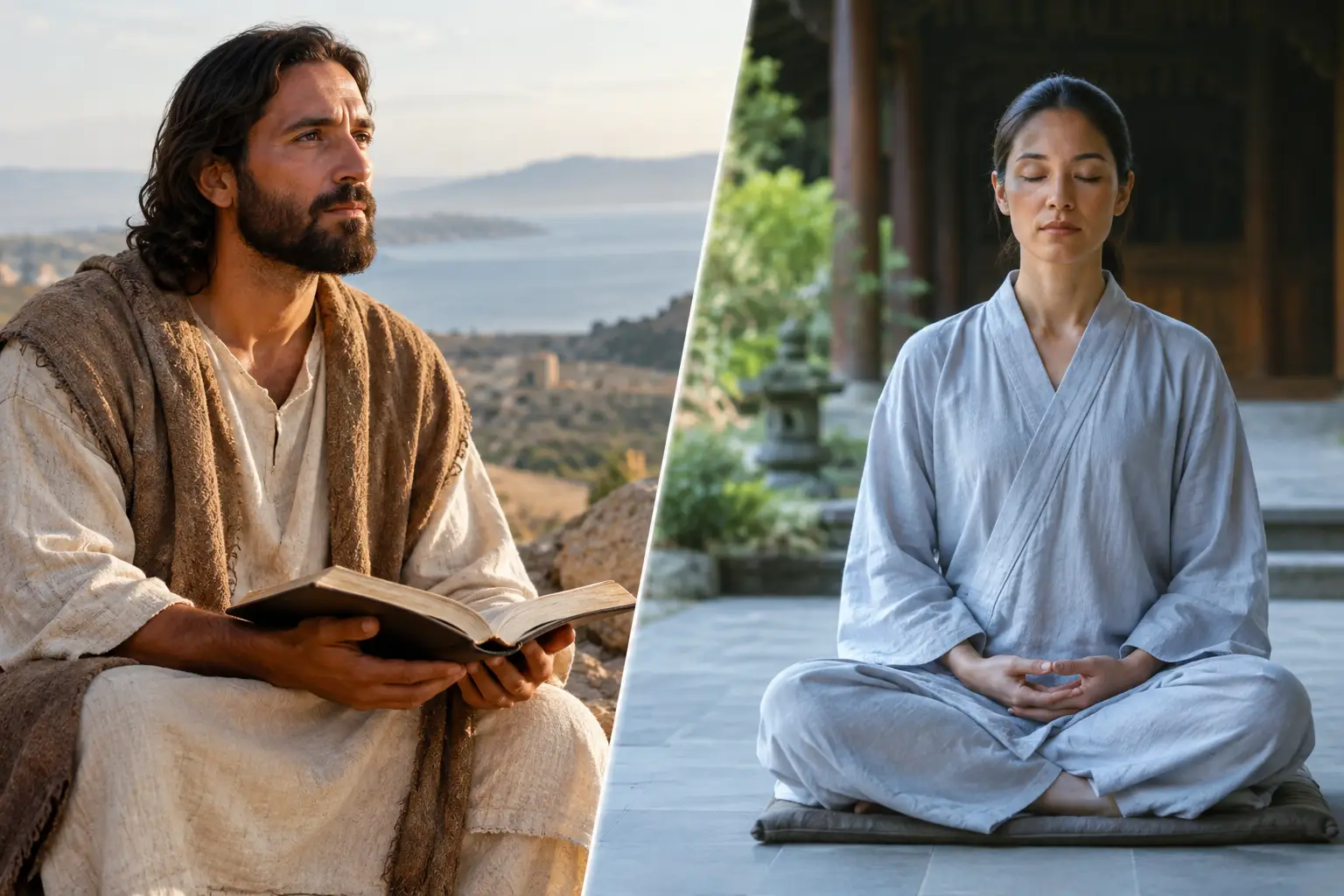
A quiet room, a slow breath, and a few uninterrupted minutes can sound much the same in many spiritual practices. Yet biblical meditation versus eastern meditation is not mainly a question of posture, breathing, or whether someone sits in silence. The central question is this: What is the mind being turned toward, and for what purpose?
Jesus calls His followers into a life of abiding in Him. “Abide in me, and I in you” (John 15:4). That invitation gives Christian meditation its center. It is not an effort to discover a divine reality within ourselves or to empty the mind as an end in itself. It is a deliberate, prayerful attention to the living God, His revealed Word, and the person of Jesus Christ.
What Biblical Meditation Is
In Scripture, meditation means giving sustained thought to God’s truth so that it shapes the heart and the life. The psalmist describes the blessed person as one whose delight is “in the law of the Lord,” who meditates on it day and night (Psalm 1:2). Joshua was instructed to keep God’s Book on his lips and meditate on it carefully so that he would obey what God had commanded (Joshua 1:8).
Biblical meditation is therefore more than reading a verse quickly or gathering information about the Bible. It involves lingering over Scripture, considering its meaning in context, praying it back to God, and asking how faithfulness should look in ordinary life. Its goal is not merely calm feelings. It is trust, obedience, worship, and a renewed mind.
Jesus Himself directs His disciples toward this kind of attentive dependence. When He was tempted in the wilderness, He answered with the written Word of God (Matthew 4:1-10). When teaching about anxiety, He pointed His followers to the Father’s care and called them to seek first God’s kingdom and righteousness (Matthew 6:25-33). His words do not encourage escape from reality. They teach us to see reality under the wise and loving rule of God.
Biblical meditation also has a relational character. Christians do not meditate on an impersonal principle. We respond to the God who speaks, who has acted in history, and who has made Himself known supremely through His Son. Scripture is not a technique for self-improvement. It is God’s Word, received with humility and faith.
Biblical Meditation Versus Eastern Meditation: The Main Difference
The phrase “eastern meditation” covers many distinct religious and philosophical traditions. Their practices and beliefs are not all identical, and Christians should avoid treating every person who practices meditation as though they mean the same thing. Still, many forms of Eastern meditation are rooted in worldviews that differ fundamentally from biblical Christianity.
Some practices seek release from desire, suffering, or the sense of individual self. Others pursue heightened awareness, inner stillness, or union with an ultimate reality understood differently from the personal Creator revealed in Scripture. A method may include repeating a sound or mantra, observing thoughts without judgment, or seeking to empty the mind of specific content.
By contrast, Christian meditation is grounded in God’s revelation. The Christian does not seek to dissolve the self into the divine or discover that the self is divine. We come before the Creator as His creatures, and before the Savior as sinners in need of grace. We are not trying to silence truth but to receive it more deeply.
This distinction affects purpose as well as practice. Biblical meditation seeks a mind renewed by God’s truth (Romans 12:2). It helps believers love God with all their heart, soul, mind, and strength, as Jesus commanded (Mark 12:30). It prepares us to follow Him when His teaching confronts our habits, fears, ambitions, and assumptions.
A person may experience temporary relaxation through many quiet practices. Physical stillness and slow breathing can be helpful ways to settle the body, especially in a distracted life. But relaxation is not the measure of spiritual truth. A practice should be evaluated by its source, its view of God and humanity, and the fruit it produces. Does it lead us toward Christ, His Word, prayer, humility, love, and obedience? Or does it direct us away from the God who has spoken?
Does Jesus Teach Meditation?
Jesus does not use the modern phrase “meditation technique,” but His teaching calls for deep, attentive engagement with God and His Word. He often withdrew to pray (Luke 5:16). He taught His followers to pray to their Father, not to perform for an audience (Matthew 6:5-13). He urged them to hear His words and put them into practice, comparing such a person to one who builds a house on rock (Matthew 7:24-25).
Notice the movement in Jesus’ teaching: hear, receive, trust, obey. Christian meditation belongs in that movement. It is not an isolated spiritual exercise that ends when the quiet time is over. It is meant to form people who forgive as they have been forgiven, tell the truth, serve rather than seek status, love their enemies, and remain faithful under pressure.
Jesus also warns against empty religious repetition. In Matthew 6:7, He cautions His followers not to heap up empty phrases as though many words could force God to hear them. This does not forbid repeated prayer or repeated Scripture. Jesus Himself repeated words in prayer in Gethsemane (Matthew 26:44). The warning is against treating words as a mechanism rather than speaking to the Father with a sincere heart.
That principle is helpful when evaluating any meditation practice. Repeating a biblical phrase slowly can be meaningful when it helps a believer attend to its truth and pray in response. Repeating words as a spiritual formula meant to alter consciousness or produce spiritual power is something different.
A Simple Way to Practice Biblical Meditation
Begin with a short passage, preferably from the words of Jesus or a passage that helps explain His teaching. Read it slowly two or three times. Ask what the text says about God, what Jesus is calling His followers to believe or do, and what the passage reveals about your own heart.
Then turn the passage into prayer. If you are meditating on Jesus’ words, “Do not be anxious about tomorrow” (Matthew 6:34), name your real concerns before the Father. Ask Him for the grace to trust Him today. Consider one faithful action you can take, such as making peace with someone, serving quietly, or refusing to let worry govern your decisions.
It can help to write down a sentence from the passage and return to it during the day. This is not about forcing an emotional experience. Some days will feel deeply encouraging; others may feel ordinary or even difficult. The lasting value is found in returning to God’s Word and allowing it to correct, comfort, and direct you.
Biblical meditation should also remain connected to the whole life of faith: gathered worship, wise Christian community, obedience, and regular study of Scripture. A verse should not be detached from its context or made to say what we already want to hear. God’s Word is meant to lead us into truth, not simply confirm our preferences.
Stillness With a Christ-Centered Purpose
The Christian faith does not fear quietness. “Be still, and know that I am God,” Scripture says (Psalm 46:10). But biblical stillness is never empty of God. It rests in His character, listens to His Word, and responds in faith.
For believers comparing spiritual practices, the wisest starting point is not whether a practice feels peaceful, popular, or productive. Start with Jesus. Listen carefully to His words. Let His teaching define what communion with God looks like. As you make room for quiet, fill that space with the truth of Christ, and ask the Father to make His Word visible in the way you live.
Leave a Reply