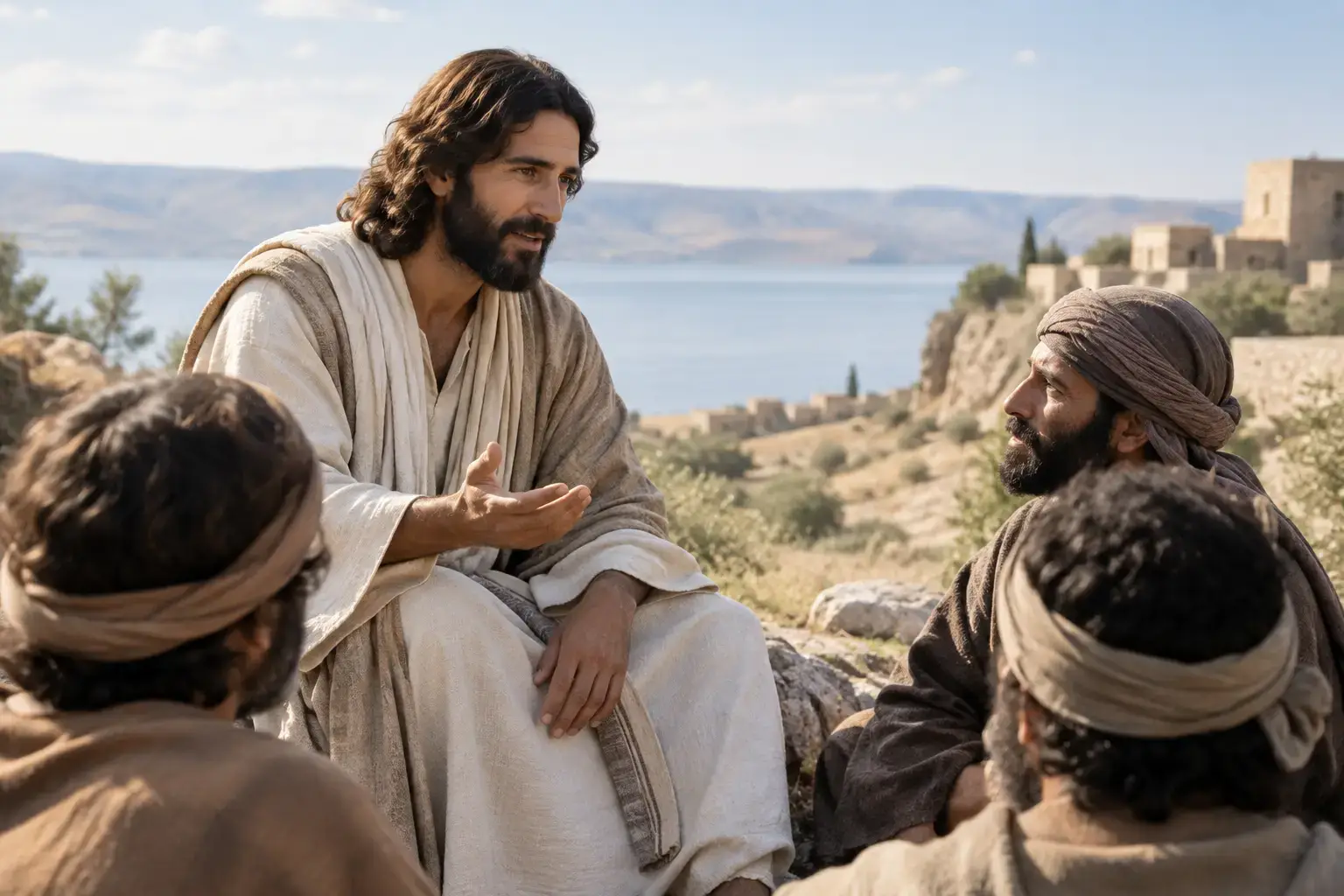
A house can look secure until the storm arrives. Jesus used that vivid picture to expose a difference that can remain hidden in ordinary religious life: the difference between listening to His words and building a life upon them. Hearing versus doing scripture is not a minor question of spiritual discipline. It reaches the foundation of what it means to call Jesus Lord.
Jesus’ Warning About Hearing Without Doing
At the end of the Sermon on the Mount, Jesus said, “Everyone who hears these words of Mine and acts on them may be compared to a wise man who built his house on the rock” (Matthew 7:24). Rain fell, floods came, and winds struck the house, yet it stood because it had a foundation.
Jesus then gave the contrasting picture: “Everyone who hears these words of Mine and does not act on them will be like a foolish man who built his house on the sand” (Matthew 7:26). The two builders heard. Both faced the same storm. The difference was not access to Christ’s teaching, emotional response, or religious vocabulary. One acted on what he heard.
Luke records the same warning with a direct question from Jesus: “Why do you call Me, ‘Lord, Lord,’ and do not do what I say?” (Luke 6:46). This is not a call to earn God’s favor through human effort. It is a call to honest discipleship. If Jesus is truly Lord, His words carry authority in the decisions, relationships, habits, and hidden places of our lives.
The order matters. Jesus does not say that people become His disciples by performing enough good deeds. He calls people to come to Him, hear Him, and follow Him. Obedience is the fruit of trusting the One who speaks. It reveals that His words have moved beyond the ear and into the heart.
Hearing Versus Doing Scripture Is Not Knowledge Versus Grace
It would be easy to misunderstand this teaching. Scripture never presents obedience as a substitute for grace. We are saved by God’s grace, not by works that place Him in our debt. Yet the grace that saves also teaches believers to live differently. Jesus’ call to obey is not cold rule-keeping. It is the response of those who know Him and trust His wisdom.
The issue is also not whether Bible study matters. Hearing the Word is essential. Faith comes by hearing, and Christians need to read Scripture carefully, learn its context, and receive sound teaching. The problem begins when knowledge becomes a place to hide from surrender.
A person may know that Jesus commands forgiveness while continuing to nourish resentment. Another may affirm His teaching about generosity while never considering the needs of others. Someone may admire the Sermon on the Mount but set it aside when truthfulness, purity, reconciliation, or love for an enemy becomes costly. These are not merely gaps in information. They are places where the words of Jesus ask for a response.
James makes the point plainly: “Prove yourselves doers of the word, and not merely hearers who delude themselves” (James 1:22). He compares the hearer-only person to someone who looks in a mirror, walks away, and immediately forgets what he saw. God’s Word shows us who He is and also reveals what is true about us. We should not turn away unchanged.
Begin With What Jesus Actually Said
For followers of Christ, a faithful response begins by listening closely to Jesus Himself. His commands are not vague ideals. They address real life with surprising clarity.
Jesus teaches His disciples to love God with all their heart, soul, mind, and strength, and to love their neighbors as themselves (Mark 12:29-31). He tells them to forgive those who sin against them (Matthew 6:14-15). He commands truthfulness that does not depend on elaborate promises (Matthew 5:37), humility that serves rather than seeks recognition (Mark 10:42-45), and love that extends even to enemies (Matthew 5:44).
He also calls His people to abide in Him. “If you love Me, you will keep My commandments,” Jesus says in John 14:15. A few verses later He promises that the one who loves Him and keeps His commands will know the Father’s loving presence (John 14:21). Obedience is relational. It grows from love for Christ, and it leads us into a deeper experience of fellowship with Him.
This does not mean every situation has an equally simple application. A Christian may know Jesus commands generosity but need wisdom about how to steward limited resources. Reconciliation is always to be pursued where possible, yet restoring closeness after serious harm may require time, truth, repentance, and wise boundaries. Doing what Jesus says is not shallow or mechanical. It calls for prayer, humility, counsel, and a willingness to obey even when the path is difficult.
What Doing the Word Looks Like in Daily Life
Doing Scripture often begins in ordinary moments rather than dramatic ones. It may mean telling the truth when a partial story would protect your reputation. It may mean refusing to return a cutting remark, choosing prayer over retaliation, or asking forgiveness without explaining away your failure.
It can look like making room for a lonely neighbor, honoring a commitment when no one would know if you broke it, or giving quietly to meet a genuine need. It can mean turning away from entertainment, speech, or patterns of thought that feed sin. At home, it may mean patient listening, faithful service, and a willingness to put another person’s good ahead of personal convenience.
Jesus gave His disciples an unmistakable example on the night before His crucifixion. After washing their feet, He said, “I gave you an example that you also should do as I did to you” (John 13:15). The Lord took the place of a servant. Then He told them, “If you know these things, you are blessed if you do them” (John 13:17). Christian maturity is not measured merely by what we can explain. It is seen in Christlike love.
That should also give us humility. No believer obeys perfectly. We all need the mercy of God, the intercession of Christ, and the continuing work of the Holy Spirit. When the Word exposes our failure, the right response is not despair or pretending. It is repentance. We bring our sin to Jesus, receive His forgiveness, and take the next faithful step.
A Simple Way to Move From Hearing to Doing
When you read or hear a passage, pause before rushing to the next lesson. Ask first, What did Jesus say? Then ask, What does this reveal about God, His kingdom, and the life He calls me to live? Finally, ask, What specific act of faithfulness should follow?
Specificity helps. Instead of saying, “I should be more forgiving,” identify the person you need to forgive and begin praying for grace to take a truthful next step. Instead of saying, “I should love my neighbor,” consider one person whose burden you can help carry this week. Instead of saying, “I need to trust God more,” bring a particular worry to Him in prayer and choose an action consistent with that trust.
It is also wise to share that response with a mature believer. The Christian life was not designed to be lived alone. Faithful friends can encourage obedience, help us see blind spots, and remind us of grace when the cost feels heavy.
The Foundation That Holds
Jesus never invites people to admire His teaching from a safe distance. He calls them to hear His words and put them into practice. Storms do not create a foundation; they reveal one. A life shaped by Christ’s teaching will not be free from hardship, but it will rest on the One whose words are true and whose mercy is sure.
As you open Scripture today, begin with the words of Jesus. Ask Him to show you one truth to receive and one command to obey. Then, by His grace, take that next step. JesusSaid.tv exists to help believers continue that work: hearing Christ clearly, understanding His teaching in the full witness of Scripture, and living as those who trust Him.
Leave a Reply