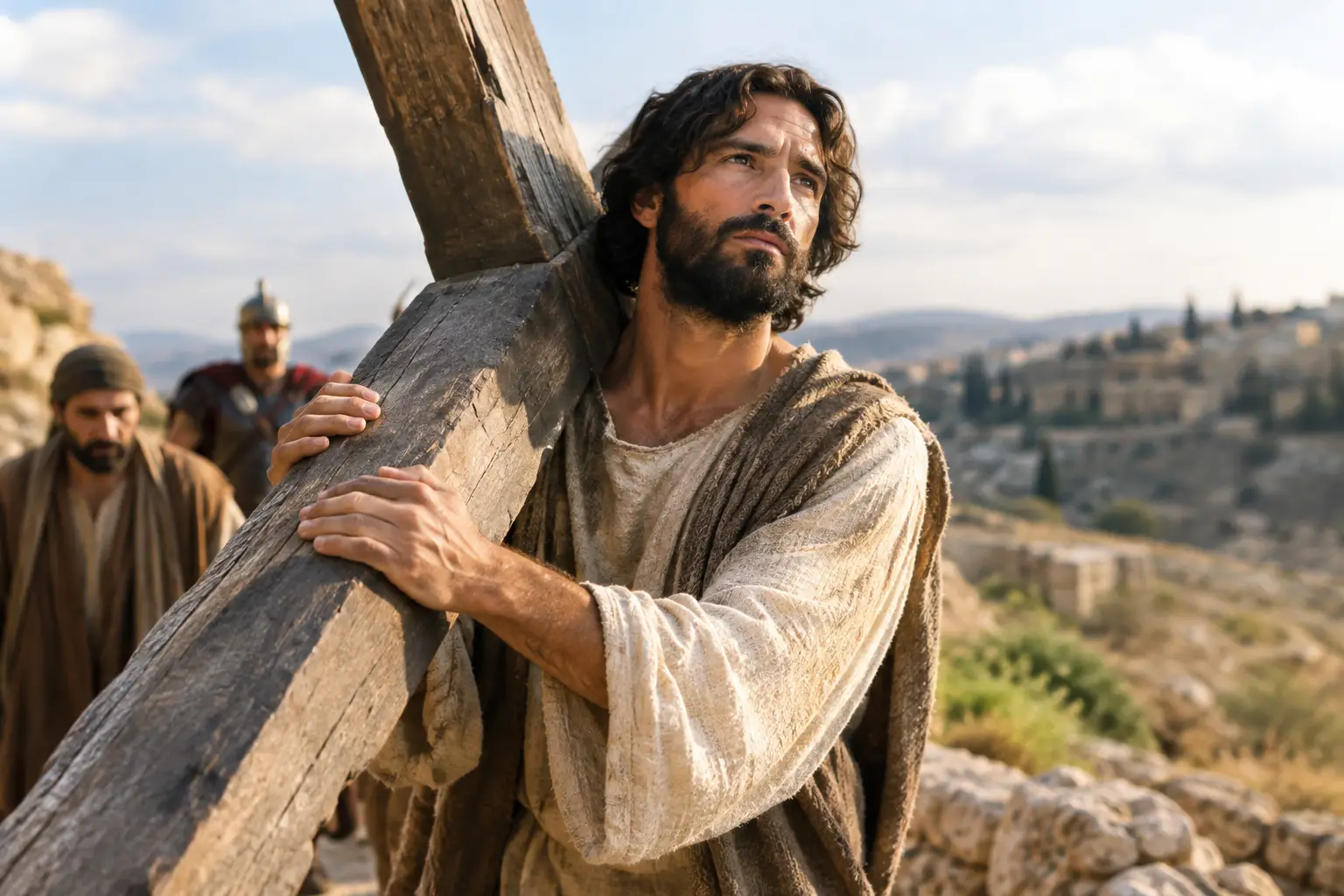
A cross was not a decorative religious symbol in first-century Judea. It was an instrument of Roman execution, humiliation, and public warning. That setting gives the phrase cross bearing meaning its weight. When Jesus told His followers to take up their cross, He was not calling them to endure a minor inconvenience or merely carry a private burden. He was calling them to a life decisively surrendered to Him.
Jesus spoke these words plainly: “If anyone would come after me, let him deny himself and take up his cross daily and follow me” (Luke 9:23). To understand this command, we must begin where Jesus began: with the invitation to come after Him.
What Does Cross Bearing Mean?
Cross bearing means accepting the cost of faithful allegiance to Jesus Christ. It is the daily choice to deny self-rule, obey His words, and remain with Him even when obedience brings loss, opposition, discomfort, or misunderstanding.
Jesus gave this instruction after Peter correctly confessed Him as the Christ. Yet Peter resisted when Jesus explained that He would suffer, be rejected, killed, and raised (Luke 9:18-22). Jesus then turned to all who wished to follow Him. The path of the Messiah would lead through suffering before glory, and those who belong to Him must not expect a path defined by self-protection or personal advancement.
This does not mean Christians earn salvation by suffering. Jesus alone bore the cross that atoned for sin. His death was unique and sufficient. Believers do not repeat His sacrifice; they respond to His saving grace by following the Lord who gave Himself for them.
Jesus Defines the Cost of Following Him
The words “deny himself” are central to the cross bearing meaning. Self-denial is more than saying no to a particular desire for a season. It is a change of allegiance. Rather than treating our preferences, ambitions, comfort, reputation, or desires as final authority, we submit them to Jesus.
This can be quiet and ordinary. A disciple may tell the truth when dishonesty would be easier, forgive when resentment feels justified, resist sexual sin, serve without recognition, or speak of Christ with humility despite the risk of rejection. In each case, the question is not, “What costs me the least?” but, “What does Jesus ask of me?”
Jesus added a surprising promise: “For whoever would save his life will lose it, but whoever loses his life for my sake will save it” (Luke 9:24). He is not glorifying pain for its own sake. He is exposing the false promise of a self-centered life. A person can preserve comfort, status, and control, yet lose what matters most. The life surrendered to Christ is the life truly found in Him.
“Daily” Makes This Personal
Luke records a word that adds needed clarity: “daily.” Cross bearing is not reserved for a dramatic moment, a missionary calling, or a crisis of persecution. It is the repeated pattern of a disciple’s life.
Each day presents fresh opportunities to follow Jesus. We may need to lay down a harsh response, an anxious effort to control outcomes, a desire to be praised, or a reluctance to obey a command that challenges us. Daily cross bearing grows out of daily fellowship with Christ. Without knowing His words, it is easy to confuse our own impulses, traditions, or fears with His will.
For this reason, Christian discipleship cannot be reduced to admiring Jesus from a distance. He calls people to learn from Him, trust Him, and walk in His way. His command is costly, but it is never empty. The One who calls us to follow also gives grace, forgiveness, wisdom, and the presence of the Holy Spirit.
What Cross Bearing Does Not Mean
The phrase is sometimes used loosely for any hardship: a difficult job, a recurring illness, a strained relationship, or an inconvenient responsibility. God certainly meets His people in every hardship, and believers are called to endure trials with faith. But not every burden is automatically “a cross” in the sense Jesus meant.
Cross bearing is specifically connected to following Christ. It is the cost that may come because we belong to Him and choose obedience to His teaching. A hardship may become part of cross bearing when faithfulness to Jesus requires us to meet it with truth, patience, integrity, or sacrificial love.
Nor does Jesus call His followers to seek suffering, accept abuse, or remain in avoidable danger simply to prove devotion. Jesus Himself sometimes withdrew from those seeking to harm Him because His appointed hour had not yet come (John 7:30; 8:59). Wisdom, appropriate boundaries, and seeking help are not failures of faith. The issue is whether fear or self-interest keeps us from obeying Christ.
Cross bearing also does not authorize us to impose unnecessary burdens on others. Jesus rebuked religious leaders who loaded people with heavy burdens while refusing to help them (Matthew 23:4). His yoke is easy and His burden is light because He is a gracious Master who gives rest to those who come to Him (Matthew 11:28-30). The call to follow Him is serious, but it is never cruel.
The Cross Comes Before the Crown
Jesus repeatedly prepared His disciples for the reality that the world may reject those who follow Him. “If they persecuted me, they will also persecute you,” He said (John 15:20). Faithful witness may cost approval, opportunities, relationships, or security. Believers in different places experience that cost in different ways.
Yet Jesus also spoke words of deep encouragement: “In the world you will have tribulation. But take heart; I have overcome the world” (John 16:33). The cross is not the final word. Jesus rose from the dead, and His resurrection gives hope to everyone who follows Him. Christian endurance rests not on grim determination but on confidence in the victorious, living Christ.
This is why Scripture joins suffering with hope. The apostles rejoiced that they were counted worthy to suffer dishonor for the name of Jesus (Acts 5:41), not because dishonor was pleasant, but because allegiance to Christ was worth more than public approval. Their example reminds us that faithfulness may be costly, but Jesus is not a distant observer of that cost.
How to Take Up Your Cross Today
Begin with Jesus’ actual commands. Read the Gospels carefully and ask where His words confront your habits, attitudes, and priorities. His teaching to love enemies, forgive others, reject hypocrisy, seek first God’s kingdom, serve rather than grasp for greatness, and remain in His word all has practical force.
Then obey the next clear step. Cross bearing is usually not about imagining future sacrifices. It is about faithfulness in the present. If reconciliation is needed, pursue peace as far as it depends on you. If you have wronged someone, confess it. If generosity is called for, give freely. If Christ’s name must be spoken, speak with gentleness and respect.
Finally, do not carry the cross in isolation. Jesus formed disciples into a community. The church is called to encourage one another, bear one another’s burdens, pray together, and stir one another toward love and good works. We follow a personal Savior, but we are not meant to follow Him alone.
The cross bearing meaning becomes clearer when we keep our eyes on Jesus Himself. He did not call people down a road He refused to walk. He loved the Father, gave Himself for sinners, and rose in victory. As you hear His call today, ask not merely what you must give up, but whom you are following. The answer is Jesus Christ, and His words lead to life.
Leave a Reply