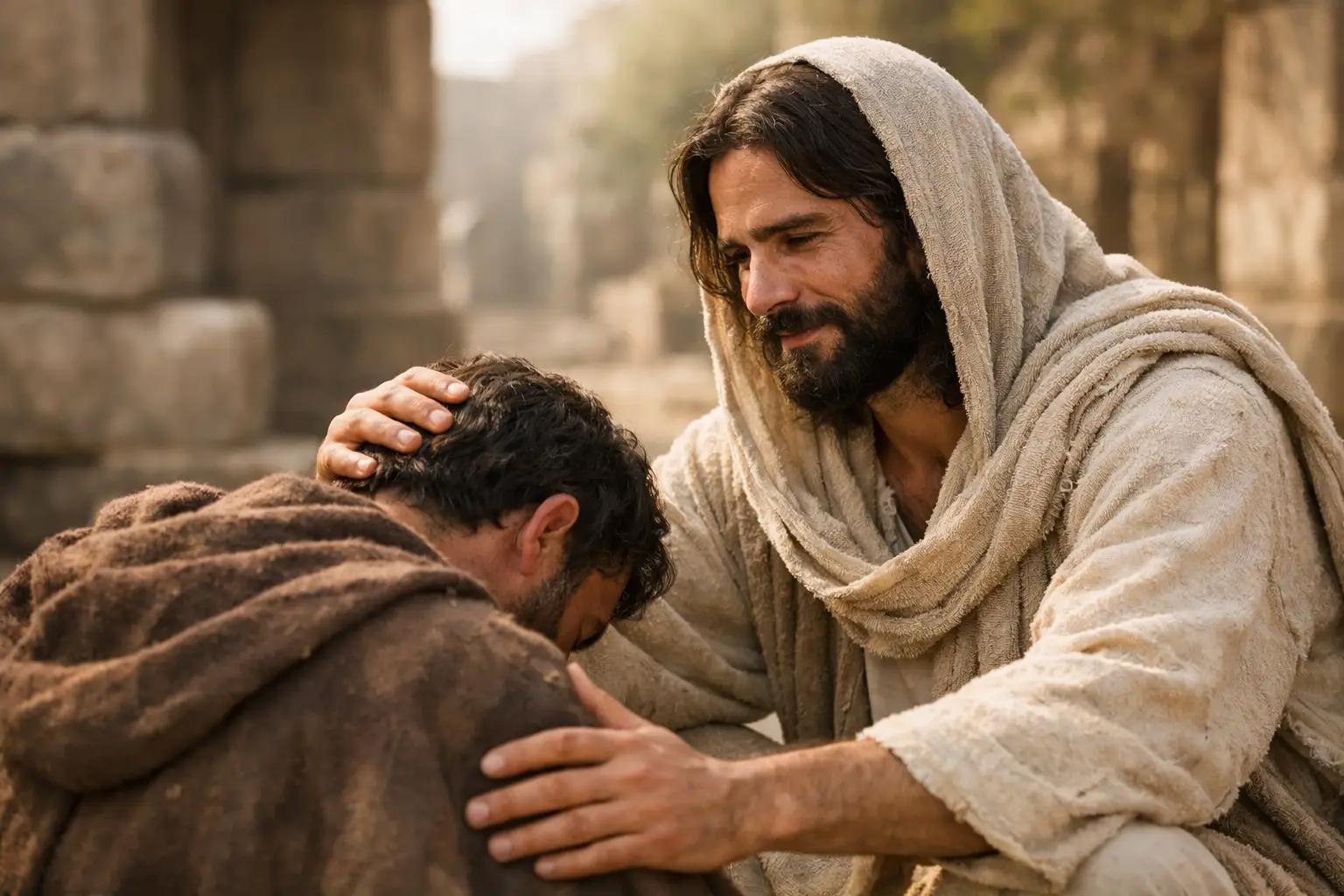
A question about forgiveness often rises from a wound with a name: a harsh word from a parent, betrayal by a friend, a broken promise in a marriage, or harm that has never been acknowledged. What did Jesus say about forgiveness when the offense is real and the pain has lasted? His words are both clear and searching. He calls His followers to forgive, not because sin is small, but because they have received mercy from God.
Jesus did not treat forgiveness as a vague feeling or a polite religious ideal. He placed it near the center of life with God and life with one another. His teaching confronts our desire to keep a record of wrongs, while also offering hope to people who carry the heavy burden of resentment.
What Did Jesus Say About Forgiveness?
Jesus taught plainly in Mark 11:25: “Whenever you stand praying, forgive, if you have anything against anyone; so that your Father also who is in heaven may forgive you your trespasses.” In the pattern of prayer He gave His disciples, Jesus likewise taught them to ask, “Forgive us our debts, as we also have forgiven our debtors” (Matthew 6:12).
These words connect receiving God’s forgiveness with extending forgiveness to others. Jesus is not saying that we earn God’s mercy by performing an act of mercy. The whole message of the gospel stands against the idea that sinners can purchase grace. Rather, He exposes a serious contradiction: a person who knows he or she needs God’s undeserved forgiveness cannot rightly cling to an unforgiving spirit toward another.
Forgiveness is therefore not merely a private emotional exercise. It is a response to the mercy of God. Those who come honestly to the Father know that their own debt of sin is greater than they could ever repay. That reality changes how they see the debts others owe them.
The parable of the unforgiving servant
Matthew 18:21-35 gives Jesus’ fullest teaching on this question. Peter asked whether forgiving someone seven times would be enough. Seven likely sounded generous. Jesus answered, “I do not say to you seven times, but seventy-seven times,” meaning forgiveness must not be measured by a limited quota.
Jesus then told of a servant whose master forgave an immense, unpayable debt. Yet that same servant went out and violently demanded payment of a much smaller debt from a fellow servant. He had received extraordinary mercy but refused to show even a small measure of it.
The point is not that the wrongs committed against us are imaginary or insignificant. Jesus knows human sin more truthfully than any of us do. The point is that God’s mercy toward repentant sinners is immeasurably great. A forgiven heart is meant to become a forgiving heart. When mercy stops with us, we have failed to understand what we have received.
Jesus Commands Repeated Forgiveness
Luke records a similarly challenging instruction: “If your brother sins, rebuke him, and if he repents, forgive him, and if he sins against you seven times in the day, and turns to you seven times, saying, ‘I repent,’ you must forgive him” (Luke 17:3-4).
Notice the honesty in Jesus’ words. He does not tell His disciples to pretend sin did not happen. “Rebuke him” recognizes that wrongdoing should be named truthfully. Biblical forgiveness is not denial, flattery, or a refusal to address what is wrong. Love speaks truth.
Yet when repentance is expressed, Jesus commands forgiveness again and again. This is demanding because repeated offenses can make trust difficult. Still, forgiveness means releasing personal vengeance and refusing to make another person’s past failure the permanent basis of our treatment of them.
Jesus’ teaching also explains why forgiveness cannot depend entirely on whether we feel ready. Feelings matter, and deep wounds may require time, prayer, wise counsel, and patient care. But Jesus calls His people to a settled direction of the heart: we will not nurture revenge. We will bring our pain before God and entrust justice to Him.
Forgiveness Is Not the Same as Trust or Reconciliation
One common misunderstanding makes Jesus’ command seem either impossible or unsafe. Forgiveness, reconciliation, and restored trust are closely related, but they are not identical.
Forgiveness is the decision before God to release vengeance and refuse to hold someone’s sin as a personal debt to be collected. Reconciliation is the restoration of a relationship, which ordinarily involves truth, repentance, and a willingness from both people to pursue peace. Trust is rebuilt through demonstrated faithfulness over time.
This distinction matters especially where there has been abuse, manipulation, criminal behavior, or ongoing danger. Jesus never commands a person to remain exposed to harm. Seeking safety, involving appropriate authorities, establishing clear boundaries, or limiting contact may be wise and necessary. Forgiving an offender does not mean calling evil good or removing every consequence from their actions.
Jesus Himself modeled both grace and truth. He forgave sinners, welcomed the humble, and called people to turn from sin. His mercy was never approval of rebellion. Christians can follow that same pattern: speak honestly, pursue peace where possible, and refuse revenge while exercising wisdom.
Jesus Forgave Those Who Wronged Him
The clearest picture of Jesus’ teaching is Jesus Himself. As He was crucified, He prayed, “Father, forgive them, for they know not what they do” (Luke 23:34). He spoke these words while enduring public rejection, false accusation, mockery, and violence.
Christ’s prayer does not minimize the guilt of those involved in His crucifixion. The cross reveals the seriousness of sin. At the same time, it reveals the depth of God’s mercy. Jesus did not answer hatred with hatred. He placed Himself in the Father’s hands and opened the way for forgiveness through His sacrificial death and resurrection.
For Christians, this is more than an inspiring example. It is the foundation for forgiveness. Ephesians 4:32 says, “Be kind to one another, tenderhearted, forgiving one another, as God in Christ forgave you.” The apostle’s instruction echoes the teaching and example of Jesus: because we have been forgiven in Christ, we are called to forgive.
That does not make obedience effortless. Some forgiveness is a decisive choice made in a single conversation or prayer. Other forgiveness is a choice a believer must bring before God repeatedly as memories return and grief surfaces. In either case, the power to forgive comes not from pretending we are strong, but from remembering the grace that has met us in Christ.
How Can You Begin to Forgive?
Begin by bringing the offense into the light before God. Name what happened without excusing it. God is not offended by honest grief, anger, or confusion. The Psalms repeatedly show God’s people pouring out their hearts to Him.
Then remember your own need for mercy. This is not meant to shame a wounded person or create false equivalence between different sins. It is meant to turn every believer toward the cross, where no one stands before God as self-righteous. We forgive from the position of people who have first been forgiven.
If it is safe and appropriate, consider whether a truthful conversation is needed. Jesus taught that when a brother sins, the matter should be addressed rather than silently stored away (Matthew 18:15). At times, a direct conversation can lead to repentance and reconciliation. At other times, it may not be possible or wise. God still calls His people to release vengeance to Him.
Finally, pray for grace to desire what is right rather than what is retaliatory. That may include praying for the offender’s repentance, for protection from further harm, and for God’s justice to be done. Such prayer does not erase the past. It places the past into the hands of the Judge who sees perfectly and judges righteously.
Forgiveness may be one of the costliest ways believers follow Jesus. But it is also one of the clearest ways His mercy becomes visible in ordinary life. Bring the person, the wound, and the unfinished questions to Christ. Listen again to His words, and ask Him to form in you the mercy He has so freely shown you. Continue studying the teachings of Jesus through the resources available at JesusSaid.tv.