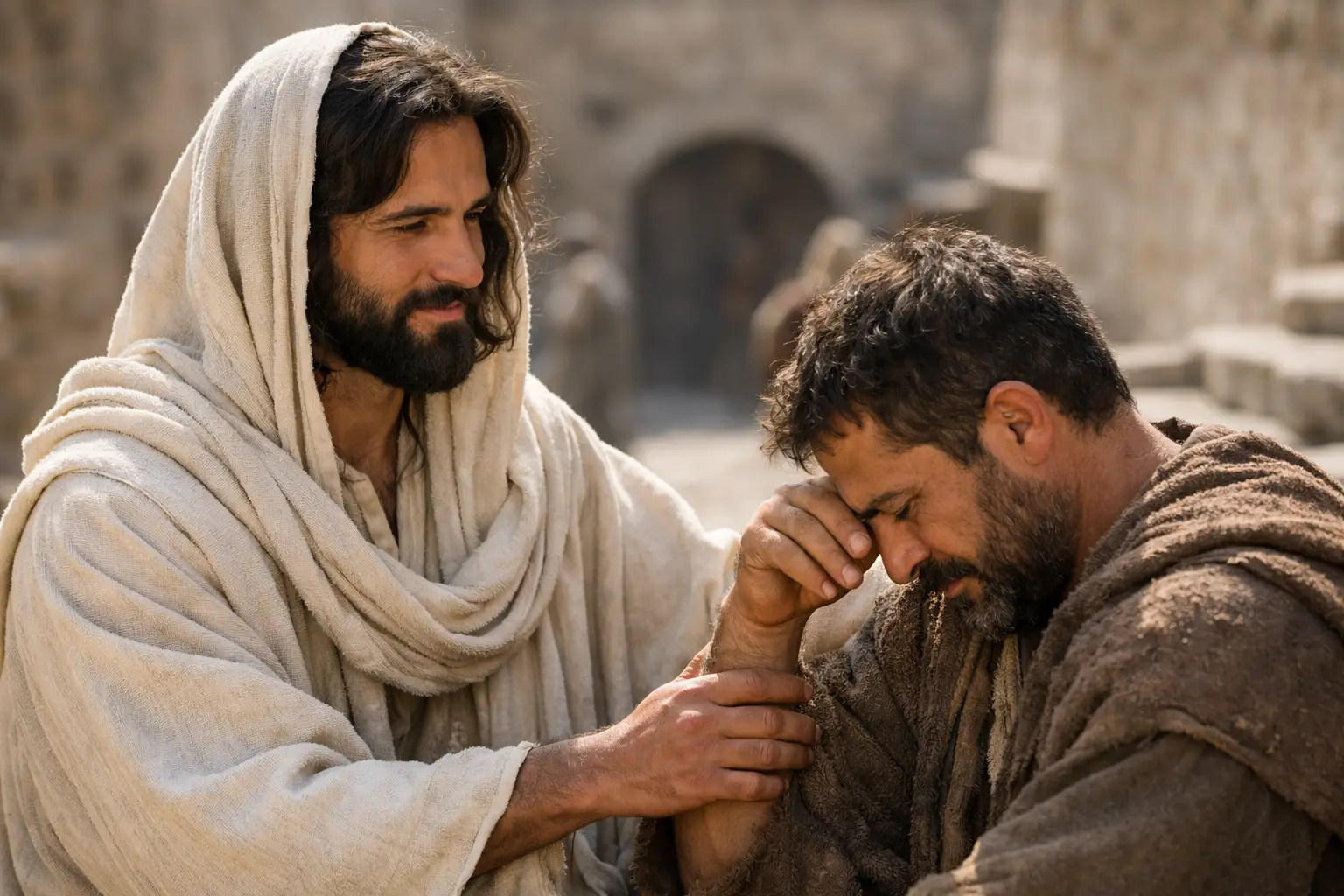
A harsh word from a family member, betrayal by a trusted friend, or an injury that changes the course of life can make forgiveness feel impossible. Yet forgiveness according to Jesus is not a vague call to be nice or pretend that pain did not happen. Jesus speaks directly to wounded people, sinful people, and people who need mercy themselves. His teaching leads us into the grace of God while calling us to surrender personal vengeance.
Forgiveness Begins With the Mercy We Have Received
When Peter asked Jesus how often he should forgive someone who sins against him, Peter suggested seven times. Jesus answered, “I do not say to you, up to seven times, but up to seventy times seven” (Matthew 18:21-22). Jesus was not setting a new maximum number. He was exposing the limits we naturally place on mercy.
Jesus then told the parable of the unforgiving servant. A servant owed his king an unpayable debt, yet the king released him from it. That same servant then refused mercy to a fellow servant who owed him a far smaller amount. The point is searching: those who have received extraordinary mercy from God cannot treat mercy as optional when others sin against them.
This does not mean another person’s wrongdoing is small. Jesus never minimizes sin. In fact, His teaching takes sin seriously enough to speak of repentance, correction, judgment, and reconciliation. But He also teaches that forgiven people are to become forgiving people. We do not forgive because evil is acceptable. We forgive because God’s mercy toward us is greater than any debt another person owes us.
What Jesus Means by Forgiveness
Forgiveness according to Jesus involves releasing a person from the debt we believe they owe us. It means refusing to nourish revenge, to keep rehearsing an offense as a weapon, or to make retaliation the purpose of our lives.
Jesus taught, “Love your enemies and pray for those who persecute you” (Matthew 5:44). This is one of His clearest and most demanding commands. Loving an enemy is not the same as approving of an enemy. Praying for a person who has harmed us does not erase the need for accountability. It does mean we place that person before God rather than appointing ourselves as the final judge.
On the cross, Jesus prayed, “Father, forgive them, for they do not know what they do” (Luke 23:34). His prayer shows the character of His mercy in the face of real injustice. The crucifixion was not a misunderstanding or a minor offense. It was the sinless Son of God suffering at the hands of sinful people. Still, Jesus did not answer cruelty with personal revenge.
His example does not make forgiveness easy. It does show that forgiveness is possible because Christ has gone before us. The Christian does not forgive by denying pain but by bringing pain under the rule of Jesus.
Forgiveness Is Not Denial, Trust, or the End of Wisdom
People sometimes hear a call to forgive and conclude that they must immediately restore every relationship to its former closeness. That is not what Jesus teaches. Forgiveness, reconciliation, and trust are related, but they are not identical.
Forgiveness is the decision to release personal vengeance to God. Reconciliation is the restoration of peace and relationship, which ordinarily requires the participation of both people. Trust is built over time through truthfulness, repentance, and changed conduct. A person may genuinely forgive someone while also recognizing that wise boundaries are necessary.
Jesus Himself taught His disciples to address sin honestly. In Luke 17:3-4, He says, “If your brother sins, rebuke him; and if he repents, forgive him.” Notice both elements. Love does not ignore sin, and forgiveness is not opposed to truthful confrontation. When a brother or sister is willing to repent, the follower of Jesus must not withhold forgiveness.
Matthew 18:15-17 also provides a pattern for seeking restoration: go privately first, involve others when necessary, and treat the matter seriously if repentance is refused. This is not permission for gossip, humiliation, or control. It is a careful path that values truth, repentance, and the health of the community.
In situations involving abuse, violence, coercion, or ongoing danger, forgiveness should never be used to pressure someone to remain unsafe. Seeking protection, involving appropriate authorities, and establishing firm boundaries can be wise and necessary. Releasing vengeance to God is not the same as enabling further harm.
The Warning Jesus Gives to the Unforgiving Heart
Jesus connects our willingness to forgive with our understanding of God’s forgiveness. After teaching the Lord’s Prayer, He said, “For if you forgive others for their transgressions, your heavenly Father will also forgive you. But if you do not forgive others, then your Father will not forgive your transgressions” (Matthew 6:14-15).
These words should be received with humility. Jesus is not teaching that we earn salvation by performing enough acts of forgiveness. Rather, He warns that a heart hardened against mercy reveals a serious problem. Someone who insists on receiving God’s grace while refusing to extend mercy to others has not understood the grace he or she claims to receive.
The parable in Matthew 18 makes the same point. The forgiven servant’s mercilessness was not a small character flaw. It revealed that the king’s mercy had not shaped him. God’s forgiveness changes the direction of a life. It creates a people who, though still imperfect, learn to forgive as they have been forgiven.
This warning invites self-examination, not despair. Many believers struggle to forgive precisely because they have been deeply hurt. The struggle itself is not proof of failure. The question is whether we will bring that struggle to Christ and allow Him to work against bitterness, resentment, and the desire to repay evil for evil.
How to Practice Jesus’ Teaching When the Hurt Is Real
Forgiveness is often a repeated act of faith, not a single emotional moment. Feelings may take time to catch up with a decision of obedience. When memories return or anger rises, we may need to place the offense before God again and refuse to feed the desire for revenge.
Begin by naming the wrong honestly before God. Jesus does not ask us to call evil good. Tell the Lord what happened, how it affected you, and where resentment has taken root. The Psalms show that God welcomes honest grief and lament.
Then remember the mercy of Christ. This is not meant to shame the wounded person. It is an invitation to stand again at the cross, where we see both the seriousness of sin and the depth of God’s love. We forgive from the place of people who have needed forgiveness.
Pray for the person who sinned against you. At first, that prayer may be simple: “Lord, I place this person in Your hands.” Over time, prayer can free the heart from rehearsing injury. Ask God to bring conviction, repentance, protection for anyone at risk, and genuine good where good is possible.
Finally, take the next faithful step. In some cases, that may be a quiet release before God. In others, it may involve a truthful conversation, a request for counsel, or a boundary that protects peace and safety. Wisdom is not the opposite of forgiveness. Wisdom helps us apply Jesus’ teaching faithfully in the circumstances before us.
A Mercy That Points to Christ
The call to forgive can feel heavy until we remember who gives it. Jesus does not stand at a distance demanding what He has never shown. He came to seek and save the lost, bore sin at the cross, and rose again to offer forgiveness and new life to all who turn to Him.
If you are carrying an offense that feels too large to release, do not force yourself into empty words. Bring it to Jesus. Ask Him to show you where vengeance has taken hold, to strengthen you for truth and wisdom, and to form His mercy in you. His command is demanding, but His grace is present, and His words lead wounded hearts toward freedom.