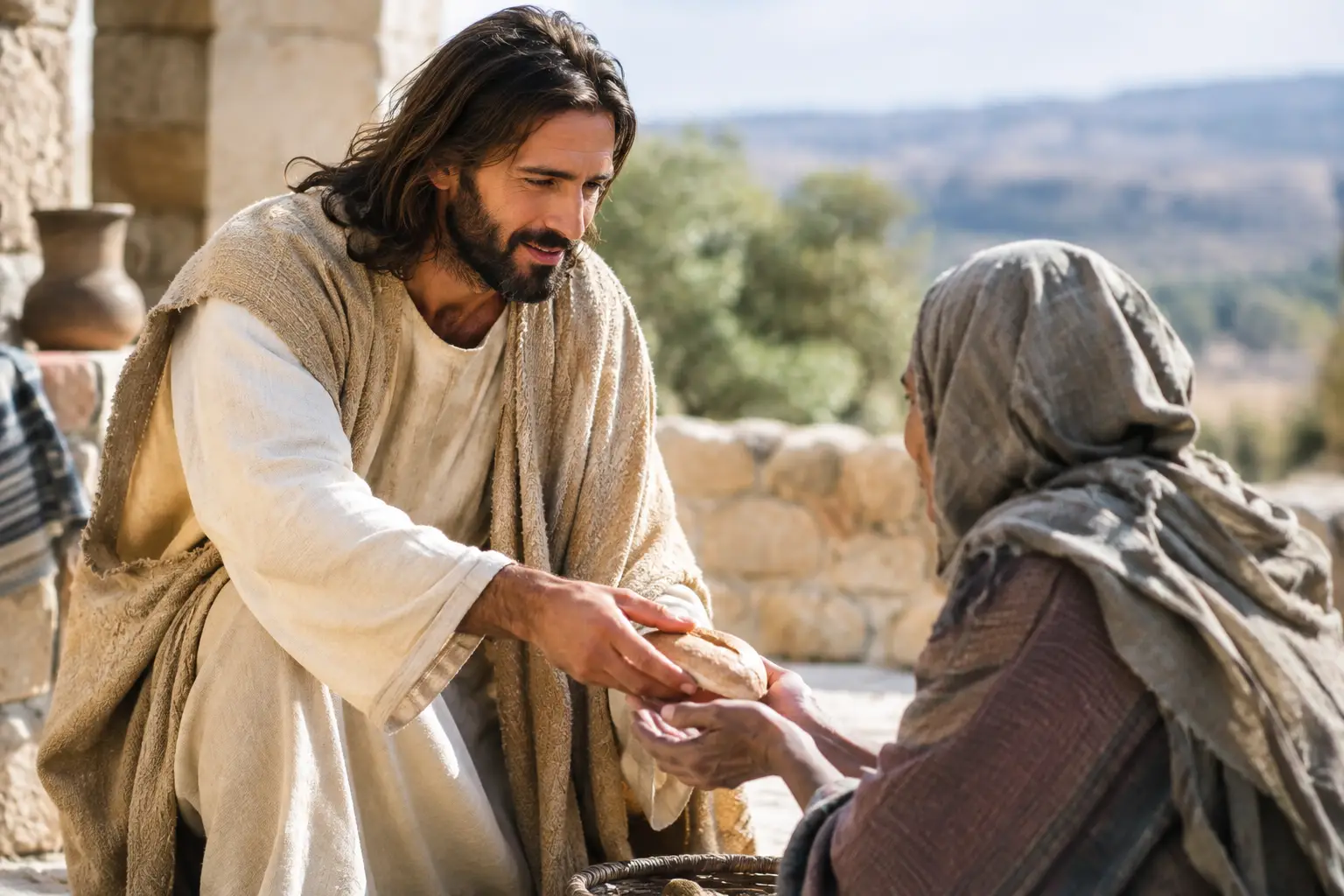
A widow placing two small coins into the temple treasury might have gone unnoticed by everyone else. Jesus noticed. While others gave from abundance, He said she had given more than all the rest because she gave “all she had to live on” (Luke 21:1-4). His words do not turn generosity into a competition or a demand for reckless giving. They reveal what Jesus teachings on generosity consistently bring into view: God sees the heart behind the gift.
For Jesus, generosity is never merely a financial transaction. It is an expression of trust in the Father, love for neighbor, freedom from the grip of possessions, and participation in God’s mercy. His teaching reaches far beyond deciding how much to place in an offering. It asks a deeper question: What do our resources, time, attention, and possessions reveal about who rules our hearts?
Jesus Teachings on Generosity Begin With Treasure
In the Sermon on the Mount, Jesus spoke directly to the relationship between possessions and devotion: “Do not store up for yourselves treasures on earth,” He taught, “but store up for yourselves treasures in heaven” (Matthew 6:19-20). Earthly wealth is vulnerable. It can diminish, disappear, or become an object of anxious protection. Treasure in heaven endures because it is bound to the kingdom of God.
Jesus then gives the reason His teaching is so searching: “For where your treasure is, there your heart will be also” (Matthew 6:21). Giving matters because the heart matters. Generosity is not a way to purchase God’s favor. The Father’s love is not for sale. Rather, giving exposes and reshapes our allegiance. When believers hold resources as gifts entrusted by God, they can use them for His purposes instead of treating them as their security.
This is why Jesus also warned that no one can serve both God and money (Matthew 6:24). He did not say that money itself is a master in every circumstance. He taught that it becomes a rival master when it claims the trust, obedience, and devotion that belong to God alone. Generosity is one practical way Christians learn to resist that rival claim.
Give to Be Seen by God, Not People
Jesus did not discourage giving in public settings, nor did He condemn every visible act of service. His concern in Matthew 6:1-4 was the desire to be praised for doing good. He warned against practicing righteousness “to be seen by them.” When human recognition becomes the goal, the applause received may be the only reward sought.
Instead, Jesus called His followers to give quietly, trusting that “your Father, who sees what is done in secret, will reward you.” This instruction corrects both pride and performance. A generous act can look impressive while remaining spiritually hollow if it is offered to build a reputation. A simple, unseen gift may carry great weight before God.
This also calls for humility when telling stories of generosity. Churches and ministries may appropriately report needs, celebrate God’s provision, and encourage faithful stewardship. Yet the focus should remain on God’s grace and the good of those served, not on elevating donors or creating pressure through comparison. Jesus directs attention away from the giver’s image and toward the Father who sees.
Generosity Sees the Person in Front of Us
When a lawyer asked Jesus, “Who is my neighbor?” Jesus answered with the parable of the Good Samaritan (Luke 10:25-37). The Samaritan did not offer distant sympathy to the wounded man on the road. He stopped, treated his wounds, carried him to safety, and paid for his care. Jesus ended with a command: “Go and do likewise.”
Generosity, in this teaching, is personal and costly. It involves interruption. The Samaritan gave time, physical effort, supplies, money, and continued concern. He helped someone whose need was immediate, even across a deeply divided social boundary.
This does not mean each believer can meet every need personally. Wisdom, responsibilities, and limited resources are real. It does mean that love of neighbor cannot remain abstract. We should ask where God has placed a need within our reach: a family under strain, an isolated neighbor, a church member facing hardship, or a ministry serving people with practical needs. Sometimes generosity is a financial gift. Sometimes it is a meal, a ride, a listening ear, or the willingness to make room in a crowded schedule.
Jesus Calls for Mercy Without Calculation
In Luke 6:30, Jesus says, “Give to everyone who asks you.” A few verses later, He adds, “Give, and it will be given to you” (Luke 6:38). These words should be received with both faith and care. Jesus is forming a merciful people, not offering a formula that guarantees material prosperity.
The surrounding context is crucial. Jesus teaches His disciples to love enemies, do good to those who hate them, lend without expecting repayment, and be merciful as their Father is merciful (Luke 6:27-36). His command confronts the instinct to give only where there is a likely return. Kingdom generosity is willing to bless others because God has been merciful to us.
At the same time, faithful generosity is not identical to careless enabling. The New Testament calls believers to wisdom, responsibility, and discernment. There are circumstances in which direct help, accountability, long-term support, or assistance through trusted local ministries may be the most helpful response. The point is not to harden the heart behind the language of wisdom. Jesus calls His people to become more merciful, not more skilled at avoiding need.
The Rich Young Ruler and the Cost of Holding Back
The encounter with the rich young ruler is one of Jesus’ clearest teachings about possessions (Mark 10:17-27). The man approached Jesus sincerely and asked what he must do to inherit eternal life. Jesus loved him, then identified the barrier in his heart: “Go, sell everything you have and give to the poor, and you will have treasure in heaven. Then come, follow me.”
The man went away sorrowful because he had great wealth. Jesus’ words reveal that possessions can become a barrier to wholehearted discipleship. The issue was not that every person must dispose of every possession in precisely the same way. Jesus knew this man’s wealth possessed him. His invitation struck at the one thing he would not surrender.
Every believer should therefore receive this passage personally. What would be difficult for us to place under Christ’s authority? Savings, comfort, status, control over our schedule, or the expectation that our future must be financially secure? Jesus does not call His followers to despise material things. He calls us to follow Him above all things.
Generosity Is a Response to God’s Care
Jesus repeatedly taught His disciples not to be consumed by anxiety over food, clothing, and tomorrow (Matthew 6:25-34). The Father knows what His children need. This promise does not deny hardship or excuse poor planning. It does free believers from the fear that says, “I must keep everything for myself because there may never be enough.”
A generous life grows where confidence in the Father grows. That confidence may lead one Christian to support a missionary, another to care for an aging parent, another to give quietly to a family in crisis, and another to offer skilled service to the church. The form will differ, but the source is the same: gratitude for God’s generosity toward us.
The early church reflected this spirit as believers shared with those in need (Acts 2:44-45; 4:32-35). Their care did not earn salvation. It gave visible evidence that the risen Christ was forming a new community marked by love. Paul later described the grace of Jesus in these words: “Though he was rich, yet for your sake he became poor” (2 Corinthians 8:9). Christian generosity begins there, with the generosity of Christ.
A Faithful Next Step
Consider one area of life that feels tightly held. Bring it honestly before Jesus. Ask Him not merely how much you should give, but what your response reveals about trust, love, and treasure. Then take one concrete step of mercy this week, without seeking recognition.
Continue studying the words of Jesus in the Gospels, paying attention to the people He noticed, the burdens He lifted, and the kingdom He proclaimed. His teaching on generosity is not a burden designed to impoverish His people. It is an invitation to live freely under the care of a generous Father.
Leave a Reply