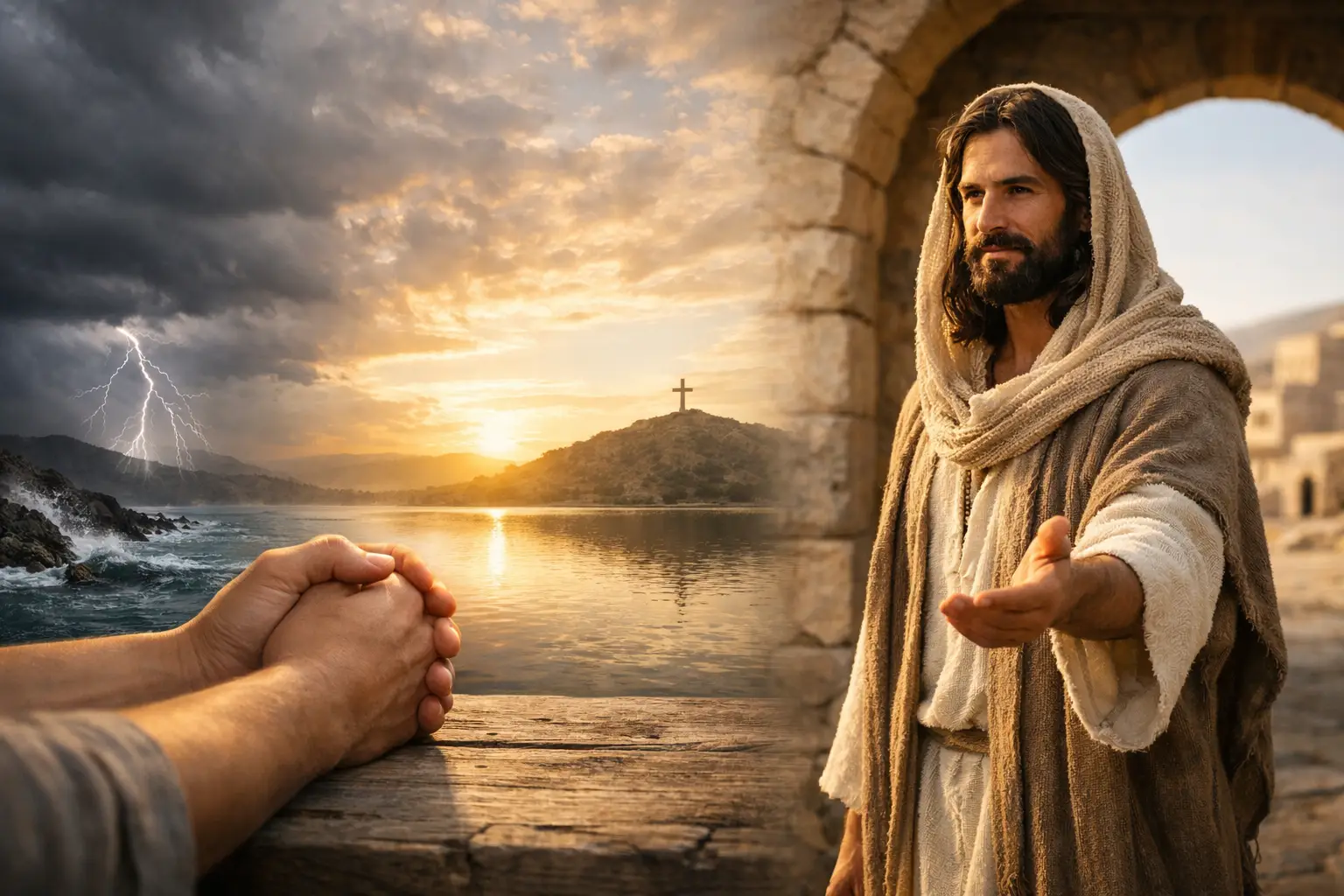
A frightening diagnosis, an uncertain job, conflict at home, or troubling news can make fear feel more immediate than faith. Yet faith versus fear is not a contest between pretending everything is fine and admitting that life is hard. Jesus never called His followers to deny reality. He called them to look at reality through the greater truth of God’s presence, care, and authority.
The question is not whether believers will ever feel afraid. Scripture shows faithful people facing danger, grief, pressure, and uncertainty. The question is where fear will lead us. Will it drive us away from trust and obedience, or will it become an occasion to hear again what Jesus has said?
Faith Versus Fear Begins With Jesus’ Presence
One of the clearest pictures appears in Matthew 8:23-27. Jesus and His disciples are in a boat when a violent storm rises. The waves are covering the boat, while Jesus is asleep. The disciples wake Him and cry, “Lord, save us! We are perishing!” Their alarm was understandable. They were in a real storm, not an imagined one.
Jesus responded, “Why are you afraid, O you of little faith?” Then He rebuked the winds and the sea, and there was a great calm. His question was not a rebuke of their desire to be saved. They did the right thing by coming to Him. The issue was that fear had become larger in their minds than the One who was with them in the boat.
This account gives a needed correction to a common misunderstanding. Faith is not confidence that storms will never come. The disciples encountered the storm while following Jesus. Faith is confidence that Jesus is present and worthy of trust when the storm comes.
That matters because fear often speaks in absolutes. It says, “This will never change,” “I cannot endure this,” or “God has forgotten me.” The words of Jesus redirect our attention. He is not distant from the weakness of His people. He receives their cries, teaches them in their fear, and shows His authority over what they cannot control.
Jesus Does Not Tell Us to Borrow Tomorrow’s Trouble
Fear frequently lives in the future. It imagines conversations that have not happened, losses that have not occurred, and outcomes that remain unknown. Jesus addressed this tendency directly in the Sermon on the Mount.
In Matthew 6:25-34, He tells His followers not to be anxious about food, drink, or clothing. Jesus is not dismissing the practical needs of life. He knows people need food and clothing. Instead, He points to the birds of the air and the lilies of the field as witnesses to the Father’s care. If God cares for His creation, how much more does He care for those made in His image and called to follow His Son?
Jesus gives His followers a different first concern: “Seek first the kingdom of God and His righteousness.” This is not an escape from responsibility. It is the right order for responsibility. A person can work diligently, make wise plans, seek counsel, and provide for a family without allowing anxiety to become the ruling voice of the heart.
Jesus concludes, “Do not worry about tomorrow, for tomorrow will worry about itself.” This does not mean Christians should never prepare for tomorrow. Planning can be an expression of wisdom. But fearful planning attempts to control every possible outcome. Faithful planning recognizes human limits and entrusts the future to God.
When tomorrow feels overwhelming, Jesus brings us back to the grace needed for today. What is the faithful step before you now? It may be making a phone call, asking forgiveness, caring for someone in need, praying with honesty, or doing the work God has already placed in your hands. Faith often grows through present obedience rather than through having every future answer.
Peace Is Rooted in Christ, Not Circumstances
Near the end of His earthly ministry, Jesus spoke to disciples who were about to face confusion, sorrow, and opposition. He did not promise them an easy path. In John 14:27, He said, “Peace I leave with you; My peace I give to you. Not as the world gives do I give to you. Let not your hearts be troubled, neither let them be afraid.”
The peace Jesus gives is different from temporary relief. Circumstances may remain unsettled. A difficult decision may still need to be made. Grief may still be deeply felt. Yet the believer can receive a settled confidence because Christ has not changed and His promises have not failed.
This peace is not produced by self-talk or sheer determination. It is received in relationship with Jesus. Earlier in John 14, He tells His disciples, “Believe in God; believe also in Me.” Biblical faith has an object. It is not faith in our own strength, positive outcome, or ability to stay calm. It is trust in the Father revealed through the Son.
That distinction protects us from disappointment. Sometimes we ask God to remove a burden, and He does. At other times, He gives sustaining grace in the middle of it. Jesus Himself told His followers that they would have tribulation in the world, but He also said, “Take heart; I have overcome the world” (John 16:33). Christian courage rests on His victory, not on a guarantee that every hardship will end quickly.
Faith Brings Fear Honestly to God
Some believers carry a second burden when they are afraid: shame. They assume fear proves they have failed God. But Jesus invites troubled people to come to Him. In Luke 12:32, He says, “Fear not, little flock, for it is your Father’s good pleasure to give you the kingdom.” The phrase “little flock” is tender. Jesus speaks as a Shepherd to people who know their need for protection.
Bringing fear to God honestly is not the opposite of faith. It can be the beginning of renewed faith. The Psalms repeatedly model this kind of prayer: fear is named, God’s character is remembered, and trust is renewed. A believer does not need polished language to pray faithfully. “Lord, I am afraid. Help me trust You and obey You today” is a sincere prayer.
We see this honesty even in Jesus’ own suffering. In the garden of Gethsemane, He was deeply sorrowful as He faced the cross. He prayed to the Father with complete openness, yet He submitted Himself fully: “Not My will, but Yours, be done” (Luke 22:42). Jesus’ prayer does not make light of suffering. It shows perfect trust in the Father amid suffering.
For His followers, faith is not emotional numbness. It is bringing our whole selves before God and choosing submission to Him even when we do not understand the path ahead.
How to Practice Faith When Fear Is Loud
Faith becomes practical when we allow the words of Jesus to shape our response. Begin by identifying the fear plainly. Is it fear of loss, rejection, illness, financial pressure, failure, or the unknown? Naming it before God prevents vague anxiety from quietly directing the day.
Then place that fear beside a specific teaching of Jesus. If you fear tomorrow, read Matthew 6:25-34. If your heart is troubled, sit with John 14. If you feel overwhelmed by opposition or hardship, consider John 16:33. Read slowly. Notice what Jesus actually promises and what He asks of His followers.
Next, take one act of obedience. Fear often urges withdrawal, silence, compromise, or frantic control. Faith may look like telling the truth with grace, continuing in prayer, gathering with other believers, giving thanks, seeking wise help, or serving someone else in love. The action may be small, but obedience teaches the heart that fear is not its master.
Finally, remember that faith is strengthened in Christian community. Jesus formed disciples, not isolated individuals. There are seasons when a trusted pastor, mature friend, or small group can help carry a burden, speak Scripture clearly, and pray when words are difficult to find. Seeking help is not a lack of faith. It can be a wise response to the care God provides through His people.
The Fear of God Reorders Every Other Fear
Scripture also speaks of the fear of the Lord, a reverent awe that recognizes God as holy, wise, and supreme. This is different from the fear that enslaves. When we rightly fear God, we stop treating human opinion, uncertain circumstances, and temporary threats as ultimate.
Jesus said in Matthew 10:28 not to fear those who can harm the body but cannot destroy the soul. His words are sobering, but they are also freeing. God alone has final authority. The believer’s life is held by the Father, and no circumstance can remove us from His care or overturn Christ’s lordship.
This does not make us careless. It makes us steady. We can make wise decisions without worshiping safety. We can grieve without surrendering hope. We can face difficult news without allowing it to define our future. The One who tells His people not to fear is the One who gave Himself for them and rose again.
When fear returns, do not assume you must solve it alone or conquer it in a moment. Return to the words of Jesus. Bring Him the truth of what you are facing, receive His care, and take the next obedient step. His words are not merely comfort for a difficult hour. They are a sure foundation on which to stand.