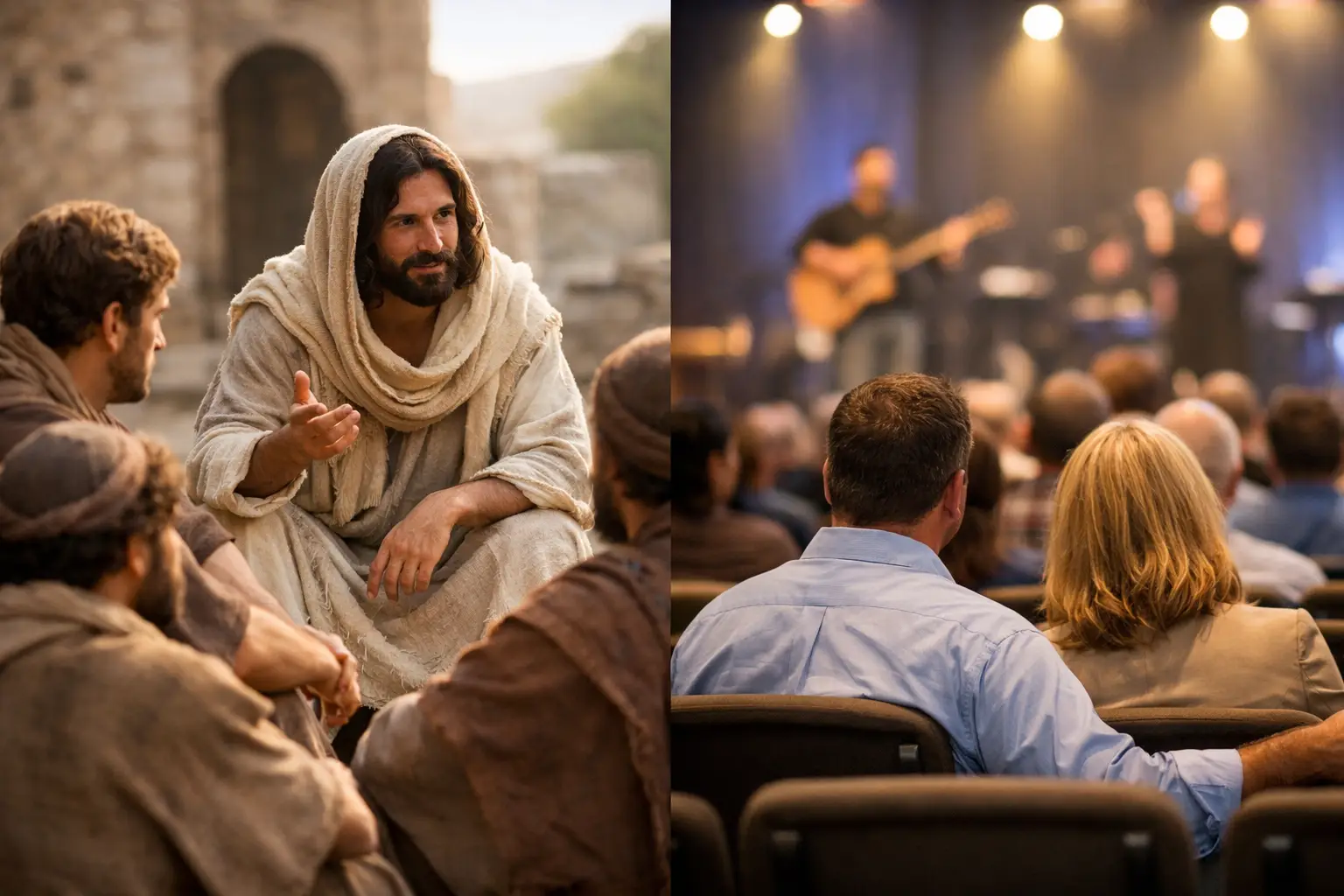
A person can know the stories of Jesus, attend church on meaningful occasions, use Christian language, and still avoid the central question Jesus asked of those around Him: Will you follow Me? Jesus discipleship versus cultural Christianity is not mainly a comparison between people who appear religious and people who do not. It is a question of whether Jesus Himself is trusted, heard, and obeyed as Lord.
Cultural Christianity can preserve valuable memories, moral instincts, family traditions, and respect for the Bible. Those things are not worthless. Yet Jesus did not call people merely to admire His teaching or include it among their inherited values. He called people to come after Him, learn from Him, and build their lives on His words.
What Is Cultural Christianity?
Cultural Christianity describes a connection to Christian beliefs, practices, or identity that is shaped primarily by family, community, history, or social custom. A person may call himself or herself Christian because that is how they were raised, because they believe in God, or because Christian values seem preferable to the alternatives.
Such an identity may include sincere elements of faith. Only God fully knows the heart. For that reason, this subject should lead to humble self-examination rather than suspicion toward others. Still, cultural connection and Christian discipleship are not identical.
Jesus addressed this difference with clarity. In Matthew 7:21, He said, “Not everyone who says to Me, ‘Lord, Lord,’ will enter the kingdom of heaven, but he who does the will of My Father who is in heaven.” His words do not dismiss confession of faith. They reveal that true confession involves more than words. Calling Jesus “Lord” has implications for how a person responds to His authority.
Cultural Christianity can make faith feel familiar without making Christ central. It can encourage people to value Christian principles while resisting the personal surrender Jesus requires. It may honor Jesus as a teacher, symbol, or source of comfort, yet stop short of receiving Him as the One whose words direct every area of life.
Jesus Discipleship Versus Cultural Christianity: The Central Difference
The clearest distinction is found in Jesus’ own invitation. “If anyone wishes to come after Me, he must deny himself, and take up his cross daily and follow Me,” Jesus said in Luke 9:23. Discipleship is not an occasional religious activity added to an otherwise self-directed life. It is a daily relationship of following Christ.
To deny oneself does not mean despising oneself or pretending that personal needs do not matter. It means yielding the right to place self at the center. The disciple learns to ask not merely, “What do I want?” but “What has Jesus taught me to do?” That question reaches into relationships, work, speech, money, forgiveness, hidden habits, and public conduct.
Jesus also used the image of a house built on a foundation. In Matthew 7:24-27, He compared the wise person to one who hears His words and acts on them. Storms came to both houses. The difference was not whether hardship arrived, but whether the house had been built on obedience to His teaching.
This is where discipleship becomes practical. Hearing Jesus’ words is essential. Studying them carefully is essential. But Jesus’ illustration presses further: His words are meant to be practiced. A life built on Christian association alone may look stable in calm weather. Obedience reveals its strength when forgiveness is costly, truthfulness is inconvenient, or faithfulness requires courage.
Disciples Learn From Jesus, Not Just About Him
There is a real difference between learning facts about Jesus and learning from Jesus. Both matter, but they are not interchangeable. It is possible to understand much of the biblical story while leaving personal patterns untouched.
Jesus said in John 8:31-32, “If you continue in My word, then you are truly disciples of Mine; and you will know the truth, and the truth will make you free.” Notice the connection between continuing in His word and being His disciple. A disciple is not defined by a brief emotional response or a religious label. A disciple remains in Christ’s teaching.
This continuing involves attention. What did Jesus actually say about loving enemies? What did He teach about prayer? How did He speak about worry, anger, marriage, generosity, humility, judgment, and serving others? These teachings cannot be reduced to inspirational phrases. They call for patient study in their biblical context and faithful application through the help of the Holy Spirit.
Cultural Christianity may treat the words of Jesus as familiar sayings. Discipleship receives them as the words of the Lord. This does not mean a disciple understands every passage immediately or obeys perfectly. Christian growth includes repentance, questions, correction, and dependence on grace. The issue is the direction of the heart: when Jesus speaks, does the believer seek to listen and obey?
Love Is a Mark of Jesus’ Disciples
Jesus gave His followers a visible mark that cannot be replaced by religious familiarity. “By this all men will know that you are My disciples, if you have love for one another” (John 13:35). This love is more than warmth toward people who are easy to love. It reflects the self-giving love Jesus showed His disciples.
Cultural Christianity can sometimes preserve outward respectability while leaving resentment, pride, contempt, or indifference unchallenged. Jesus goes beneath the surface. He teaches reconciliation, mercy, forgiveness, and care for those in need. In the Sermon on the Mount, He calls His followers to love their enemies and pray for those who persecute them (Matthew 5:44).
These commands are difficult, and they should not be handled casually. Loving an enemy does not require calling evil good, ignoring justice, or remaining in an unsafe situation. It means refusing hatred and vengeance, praying for those who have wronged us, and entrusting judgment to God. Such love points beyond human instinct to the character of Christ.
The Cost of Following Jesus Is Also a Gift
Jesus never concealed that following Him would be costly. In Luke 14:27, He said, “Whoever does not carry his own cross and come after Me cannot be My disciple.” His words confront the desire for a faith that offers comfort without transformation.
Yet the cost must be understood beside Jesus’ promises. He does not call people away from life into emptiness. He calls them from sin, self-rule, and false security into the life of His kingdom. He invites the weary to come to Him for rest (Matthew 11:28-30), while teaching them to take His yoke and learn from Him. His rest is not escape from obedience. It is the peace of belonging to a good and faithful Lord.
At times, cultural Christianity may feel easier because it asks little. It allows a person to retain Christian language without confronting cherished sins or priorities. But an easy identity cannot provide the deep assurance, transformed character, or enduring hope that comes from abiding in Christ.
A Gentle Place to Begin
The contrast between discipleship and cultural Christianity is not a reason for despair. Jesus’ call is an invitation. He welcomed imperfect people, taught them patiently, corrected them truthfully, and gave Himself for their salvation. The disciples themselves often misunderstood Him, feared opposition, and failed in moments of testing. After His resurrection, Jesus restored and commissioned them.
A helpful beginning is to read one of the Gospels slowly with a simple question in mind: What is Jesus asking of those who follow Him here? Then ask a second question: Where does this teaching meet my actual life? Perhaps it concerns an unforgiving relationship, a hidden anxiety, a habit of harsh speech, a reluctance to serve, or a decision that has been guided more by personal preference than by Christ’s command.
Bring that response to Jesus in prayer. Confess what needs to be confessed. Ask for grace to obey. Seek the encouragement of faithful believers who will help you grow in His word. Discipleship is personal, but it is not meant to be isolated. Jesus forms a people who learn to love, serve, and obey Him together.
The call of Christ remains wonderfully direct: “Follow Me.” Rather than settling for a faith that is merely familiar, let His words lead you into the daily, grace-filled work of becoming His disciple.